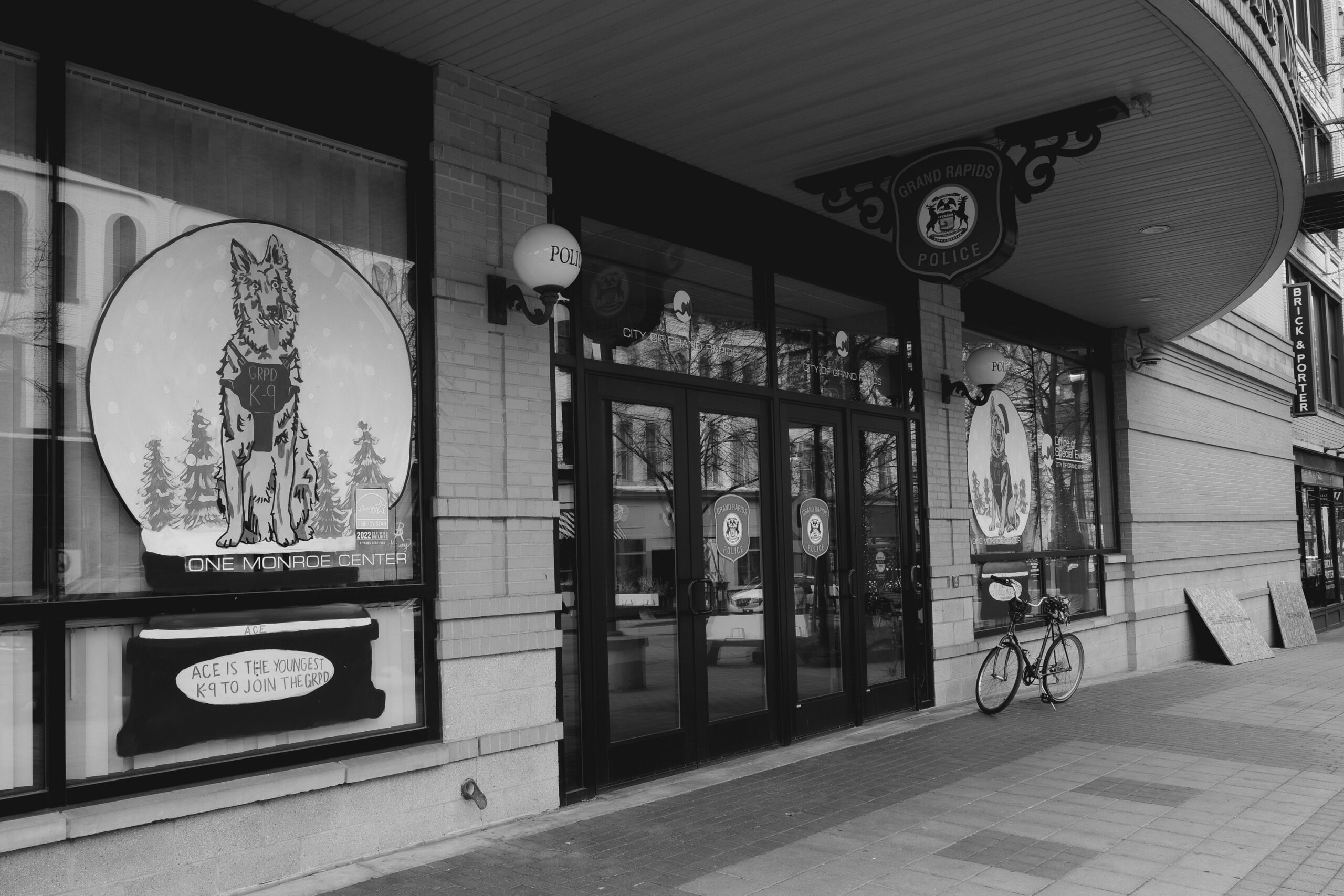
A woman whose husband claimed to have been wrongfully tased by the Grand Rapids Police Department has been appointed to the Civilian Appeals Board (CAB) by Commissioner Marshall Kilgore.
The Grand Rapids City Commission will recognize the Ward 3 Commissioner’s appointment of Kimberley Williams to the CAB at its Tuesday meeting.
The CAB is an oversight body founded in 1996 in order to hear and amplify complaints against the Grand Rapids Police Department. It works in conjunction with the city’s Office of Oversight and Public Accountability (OPA).
The CAB does not conduct initial investigations but reviews completed investigations in specific cases. The nine-member board focuses on the use of excessive force, civil rights violations, and any potential discourtesy or racial prejudice possibly shown on the part of police officers.
The board, however, is merely advisory in nature, and efforts in the past to strengthen its authority have fallen short. Williams will serve for the remainder of a two-year term ending May 3, 2027.
Her appointment to the CAB comes in the wake of a 2025 incident involving her husband, Victor Williams, the Grand Rapids Police Department, and an excessive force complaint.
Williams, a longtime trustee for the Grand Rapids Public Schools Board of Education, publicly supported the complaint lodged against Grand Rapids Police Department officers following a 2025 incident involving her husband. He was tased by police and arrested after an alleged physical altercation with law enforcement.
Video footage of the incident shows two men in a tense encounter with the police in the parking lot of a Boston Square Walgreens. One of the civilians can be seen getting into a physical altercation with police before he is tased and arrested.
Following the Williams’ subsequent allegations of excessive force, then-Police Chief Eric Winstrom defended the arresting officers, arguing that the civilians involved were repeatedly instructed to stand back but did not listen.
A Report on the State of GRPD
In an adjacent effort to address recent criticism leveled against the GRPD, City Manager Mark Washington also wrote a report on the state of the department, along with the various oversight boards and programs in place.
That report, which will likewise be presented at the City Commission’s March 17 meeting, “does not include re-investigating employee discipline that has already been decided, the current pending officer-involved shooting that is being investigated by Michigan State Police, or any matter related to pending litigation.”
Instead, it launches an investigation into the actions of city employees over the past five years. For instance, Washington writes that he has directed the interim police chief to conduct a “review and analysis of officer-involved shootings over the past five years,” reviewing the facts of each incident.
Washington promises that the city “will undertake best practices benchmarking of peer jurisdictions and national professional associations related to police pursuit policies,” specifically related to the use of canines.
The list includes items such as launching a mental health co-response team with an increased number of social workers, strengthening the Victim Services Unit and hiring a Victim Services Manager, and initiating a variety of programs designed to educate the public and scrutinize the conduct of the police department.