The Grand Rapids City Commission unanimously approved a $785.4 million budget proposal for fiscal year 2027 on Tuesday, representing an increase of about $50 million, or 6.4%, over the previous fiscal year.
Included in the budget is $10 million for the city’s Affordable Housing Fund, $75.4 million for police, and $48.3 million for fire services. During the meeting, commissioners touted the budget for both its fiscal responsibility and potential to help Grand Rapids grow.
“This year, I am pleased that we have really worked to strengthen our systems,” Commissioner Kelsey Perdue said of the budget. “It does so in an environment which is increasingly uncertain.”
Personnel costs are expected to increase 5.02% in the coming year. The city’s total personnel cost in 2027 is $236.5 million, $144.5 million of which is funded through the General Fund. The budget adds 14 new positions. City leaders also pinned the $50 million increases on “inflation and market conditions” and capital investments.
The budget sets aside $201.6 million for water and wastewater, $40.4 million for parks, and $17.8 million for the public library system. It also calls for the creation of 14 new roles outside of General Operating Fund monies: five new staff members in Environmental Services, three in water, four in Mobile GR, one in parks, and one engineering position dedicated to “Capital Management.” The budget plans for 1,805 total positions in city government in 2027.
The city will receive $1.7 million from the state of Michigan’s Public Safety Trust Fund. Anticipating this funding, the city had already approved the hiring of eight new police officers and two new sergeants in January 2026. The remaining $400,000 will go to other not-yet-specified violence prevention and public safety initiatives.
The budget also assigns $1 million to the Third Ward to address “historical under-investment.” Roughly 70% will go toward traffic and pedestrian projects, and the remaining funds will be for youth jobs and summer violence prevention programs.
Because property tax values have outpaced the rate of inflation, the property tax millage rate will fall by 0.1074 mills to 8.7513 mills. The Headlee Amendment, adopted to the Michigan Constitution in 1978, requires municipal governments to reduce millages when property value growth exceeds inflation.
Charter Compliance
Comptroller Max Frantz had warned the budget may violate the City Charter, due to part of the proposal appropriating funds to a department within the city manager’s office performing functions typically assigned to the comptroller’s office. Frantz told The Herald he believes the budget is attempting to “abolish” his charter-mandated office.
“The City also cannot delegate the charter-mandated duties of an elected official to an unelected administrator or department that is not authorized by the Charter to perform such duties,” he wrote. “The City Commission has an obligation to uphold the governance structure established by the Charter and honor the will of Grand Rapids voters. Grand Rapids voters have repeatedly voted to uphold and protect the duties and independence of the elected City Comptroller’s office.”
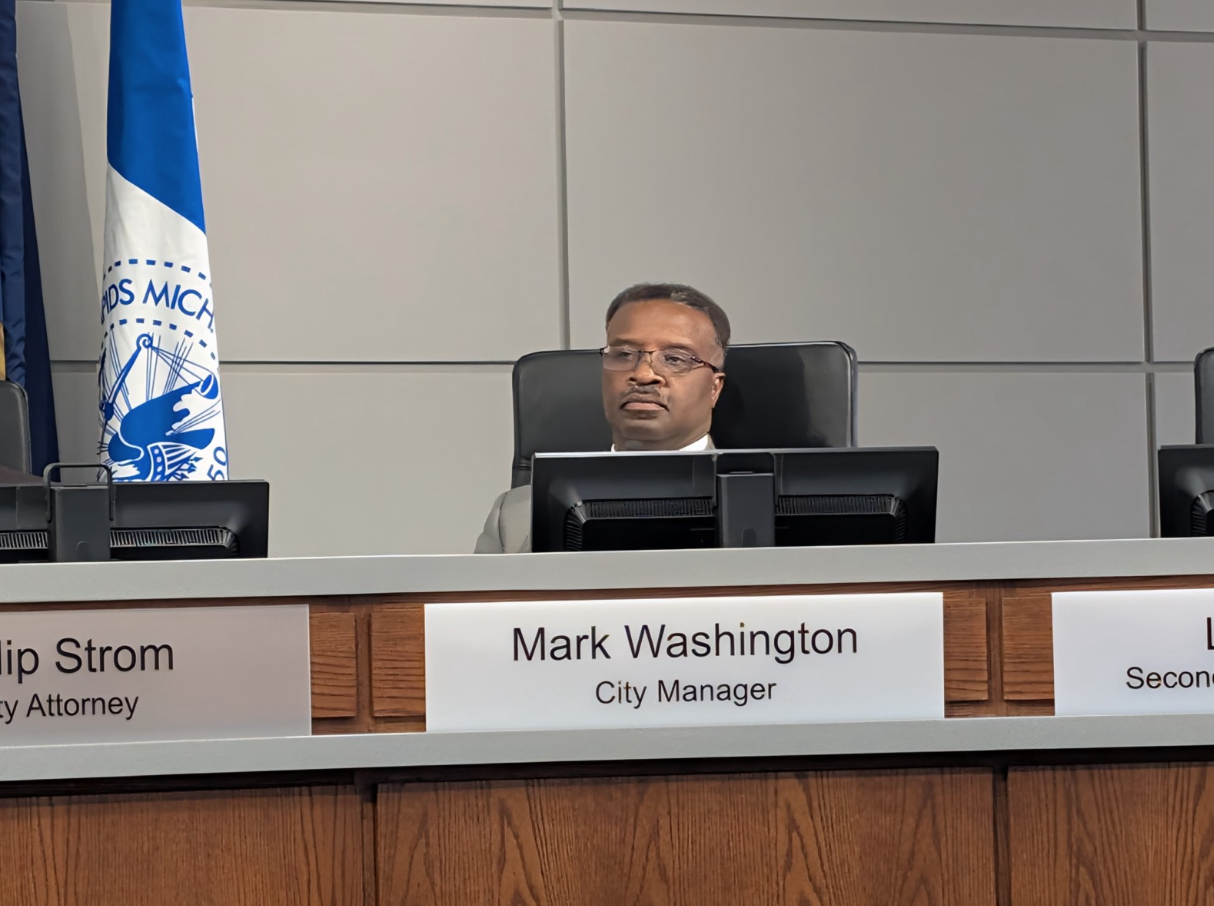
Frantz added he believes the move allows City Manager Mark Washington to consolidate power within his office, damaging resident trust in the process.
“By consolidating financial functions including budgeting, payment issuance, and accounting under the control of a City Manager, the administration has instituted a form of unilateral control over city finances that is not authorized by the City’s Charter,” he wrote. “A budget that conflicts with both the City Charter and our longstanding governance practices in Grand Rapids can undermine public trust and erode the checks and balances designed to prevent the concentration and misuse of power.”
Staffer Funding
The funding of multiple staffers to assist the commission became a major topic of debate during budget deliberations. Between a shared commission assistant and dedicated communications support, these expenses accounted for over $200,000 of general operating funds.
Commissioner Milinda Ysasi announced during the meeting she would change her vote to support the expenses after previously being opposed. She acknowledged the “deadlock” the deliberation created in the body, but added she would benefit from maintaining the staffers.
“I know for me I was like ‘I’m a no on this,’ but now I want to be able to support this in a way that is more built into our city support staff and the structure that we have,” she said.
That decision meant the budget includes an undefined $100,000 line item for “contractual services.” The commission will later decide how to use those funds and whether to amend that item to $208,485, the full amount needed to fund the staffers.
Commissioner AliciaMarie Belchak told The Grand Rapids Herald she was in favor of funding the positions as she relies on them for help in her work of serving the city.
“Instead of looking at this as ‘the commissioners are getting something out of it,’ I would really want us to look at it as ‘the public is getting something out of this,’” she said. “I think that the concerns over this being a misuse of dollars is probably misplaced in the grand scheme of things considering that we have a lot of other things going on.”
Commissioner Lisa Knight said, however, the roles should have been cut for their redundancy in addition to regular city staff.
“I don’t think it’s really a necessity because we have so many qualified city personnel that can help us navigate the things that we need to do that I think [the staffers are] a waste of money,” she said. “I think we have enough talent within the city personnel that we can utilize them for the things that we need to do… I don’t see the value in it.”
Write to jackson@grherald.com.