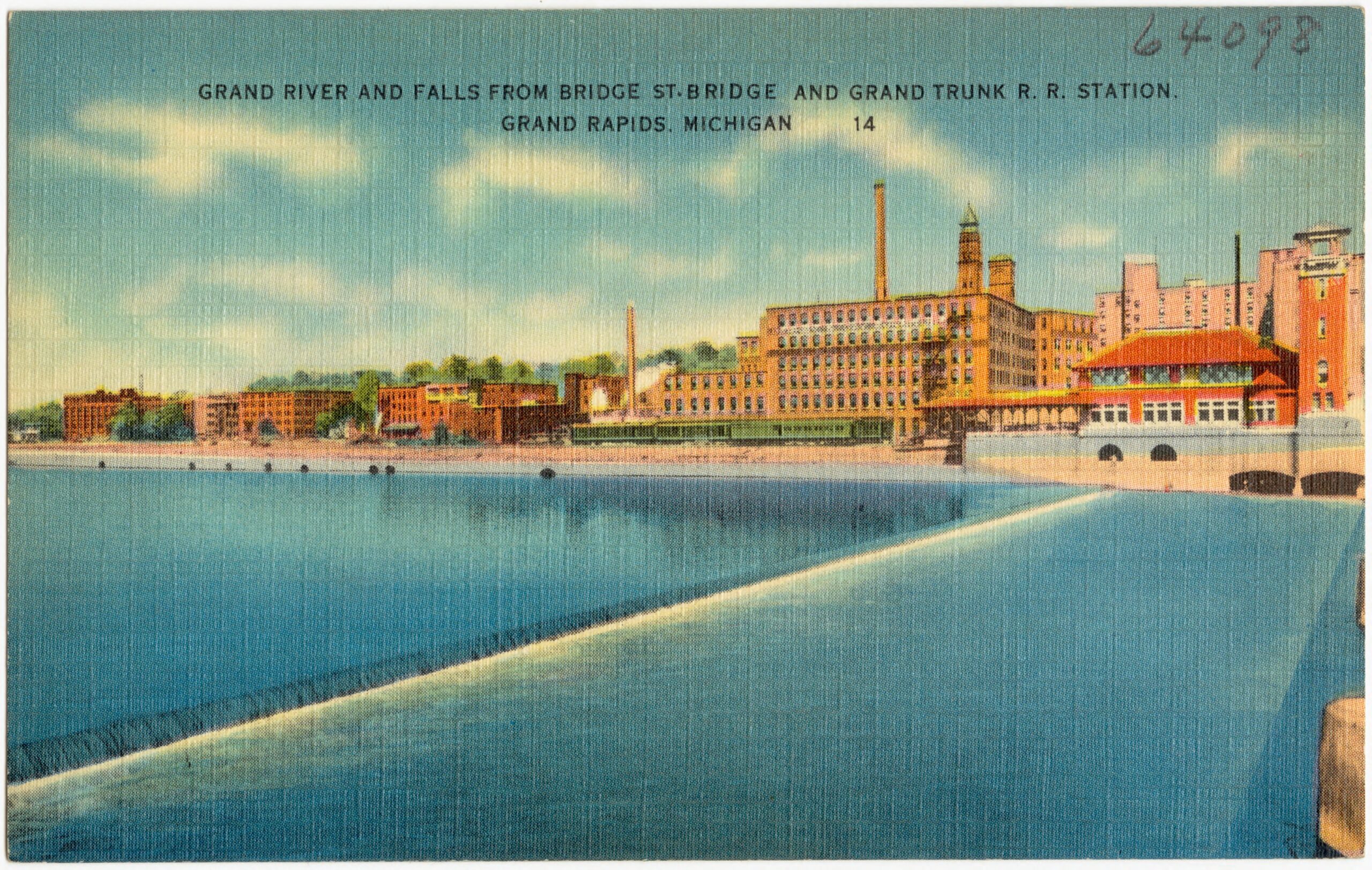
The Grand Rapids City Commission’s Community Development Committee last month approved a $67,188 agreement to involve a “qualified historian” in a project to remove several dams spanning the Grand River.
The Grand River Revitalization Project is an extension of the sustainability program Green Grand Rapids and seeks to restore powerful rapids to the Grand River. Part of this initiative involves removing four low-head dams between Bridge Street and Fuller Street downtown.
In a note on the project website, organizers note the four dams were built in the 1920s, which qualifies them for listing on the National Register of Historic Places.
“Because the project requires removal of all four low-head dams, the project does not allow for avoidance or minimization of adverse impacts to these structures and the impacts to the dams must be mitigated,” the site reads.
A 2022 Memorandum of Agreement document concerning the removal of the dams maintains that a “qualified historian” must be allowed to “monitor and document the removal of one of the structures.” To meet this requirement, the city brought on local historic preservation firm Past Perfect, Inc., which it said had submitted a bid for the project.
The organization, according to its website, functions as a consulting firm for the restoration, nomination, or development of historic properties while complying with rules and maximizing benefits like tax credits.
The measure passed the committee without discussion or a specific explanation of the firm’s involvement in the project. Past Perfect declined a request for comment from The Grand Rapids Herald regarding the nature of its work on the dams.
Funding for the project comes from an array of public and private dollars. About 36% of the money is sourced from state and local government, according to the project website.
The provision for the historian is one of multiple bureaucratic costs linked to the project. A team of divers tasked with scouring the riverbed in search of mussels in 2024 cost the city $1.26 million, a figure that is expected to grow as more mussels are unearthed during river reconstruction.
Project organizers say the dams must be removed because they “create uniform hydraulics and an un-natural aesthetics [sic] throughout the project reach.” The site adds that low-head dams also have a reputation as “drowning machines,” making them an additional public safety hazard.
Write to jackson@grherald.com.