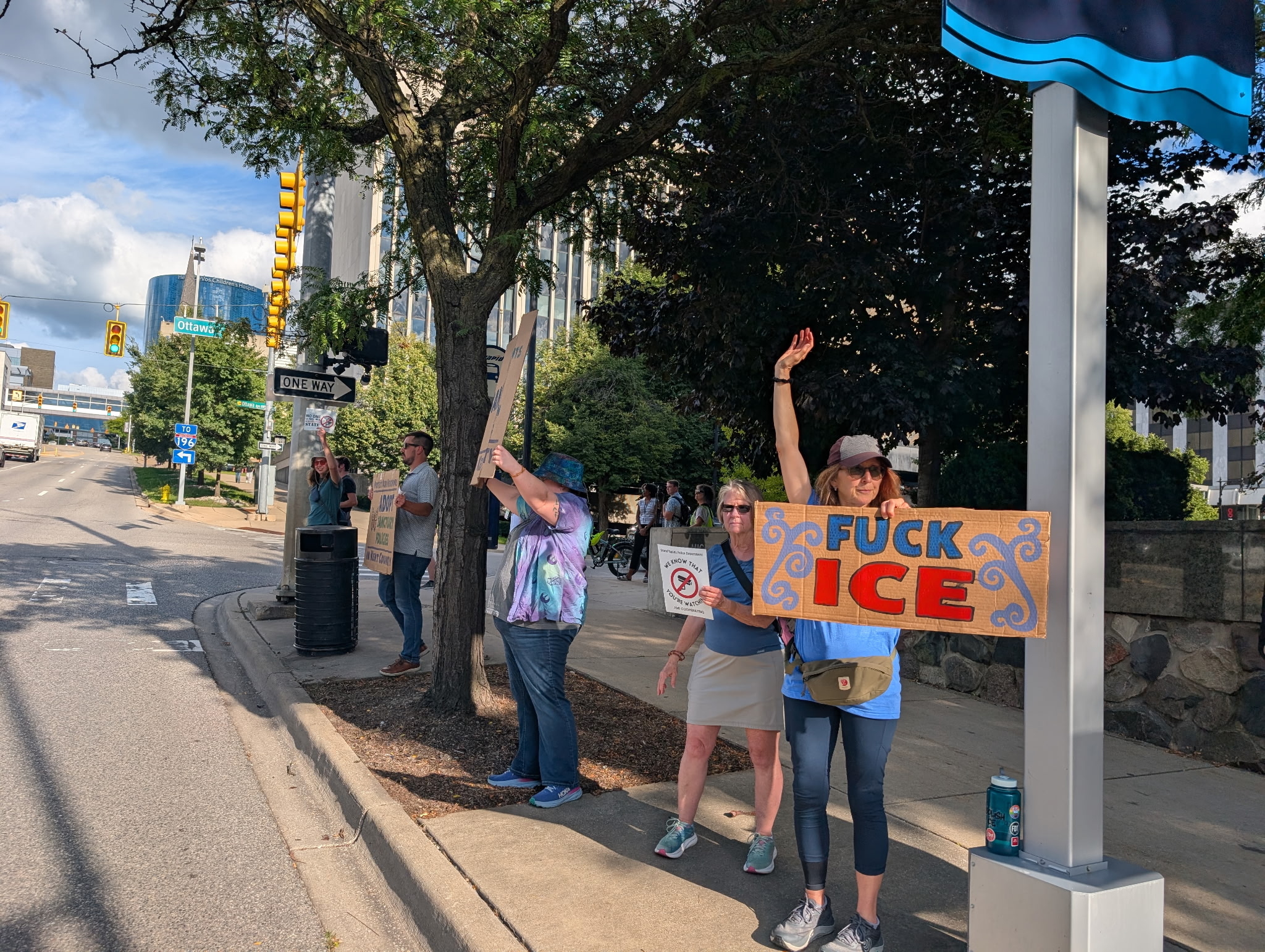
Local pushback against Immigrations and Customs Enforcement (ICE) activity in Grand Rapids is being coordinated through a network of groups with both local and national support.
Two main groups coordinate to drive anti-ICE sentiment in Grand Rapids: Movimiento Cosecha and GR Rapids Response to ICE. They work in tandem to pressure the city leaders and law enforcement to take a stand against federal immigration enforcement.
Among the groups’ priorities is a list of six sanctuary policies, which are intended to protect immigrants. Among the demands are for the city to prohibit local authorities from working with ICE, prevent the creation of detention centers, and to stop doing business with entities that have contracts with ICE.
Movimiento Cosecha
Movimiento Cosecha is a local branch of a national “non-violent movement fighting for permanent protection, dignity, and respect for all undocumented immigrants.” That group accepts donations via ActBlue, the Democratic Party’s primary donation sourcing mechanism.
The group states, however, that it does not align itself politically, adding that organizers are “tired of broken promises by political parties.”
As of 2024, the national group had $450,000 worth of assets, according to public finance documents. All of its revenue is sourced from contributions.
Nonprofit watchdog Influence Watch describes Movimiento Cosecha as using a four-step playbook to pressure political leaders into adopting its anti-ICE approach.
“Phase 1 involves training activists that can form chapters of the organization,” the site reads. “Phase 2 is creating a ‘public ultimatum’ for elected officials to take a pro-illegal immigration stance.”
“Phase 3 is launched once 50,000 activists have pledged to boycott certain stores and brands Cosecha deems not immigrant-friendly. Phase 4 involves organizing demonstrations involving ‘picketing workplaces, massive civil disobedience’ and would begin once 100,000 pledge to strike and 300,000 pledge to boycott.”
While the group maintains it has no paid staff, those who volunteer to join its “operations team” receive a $500 monthly stipend intended for “housing and groceries in a Cosecha Movement house (or in housing provided by the communities in which we work), reimbursement for minor health related costs, and transportation.”
Movimiento Cosecha Grand Rapids accepts donations, as well as “mutual aid,” which it specifies is not the same as charity. Mutual aid donations often go toward paying rent for anonymous families impacted by ICE, which is sometimes upwards of $1,000 or more.
The group’s protest efforts, which include boycotting Long Road Distillery, co-owned by Mayor David LaGrand, are frequently written about by Jeff Smith, who runs the website Grand Rapids Institute for Information Democracy (GRIID). Movimiento Cosecha Grand Rapids identifies Jeff Smith as its “compadre and trusted ally,“ and frequently involves him in its activism efforts.
The website has accused Grand Rapids Police of cooperating with ICE and created graphics to illustrate those claims. Movimiento Cosecha members notably displayed these graphics while testifying to the City Commission.
Smith was among those present when Movimiento Cosecha members derailed a City Commission meeting last month. That demonstration led to police involvement and sparked condemnation from members of the City Commission.
Smith was among four agitators found guilty of trespassing after refusing to leave the Kent County Sheriff’s Office during an anti-ICE protest in January. His own coverage of the proceedings in GRIID identified himself as acting “in conjunction with Movimiento Cosecha.”
A Facebook event calling for community “solidarity” with the defendants identified both Movimiento Cosecha and GR Rapid Response to ICE as organizers.
The group’s cofounder is Gema Lowe, who could be seen in a livestream video pushing Commissioner Marshall Kilgore to support the group’s sanctuary demands. Lowe repeatedly testifies to the City Commission using a Spanish interpreter, despite also speaking fluent English.
Lowe said in an interview that she first became aware of Cosecha in 2017 during a trip to Boston. She said that encounter led her to bring similar activism to Michigan.
“I remember, like, 400 people gathered in one room at this university,” the interview reads. “I think I was the only one with gray hair. We went to Old Navy and danced inside and shut down the store. It was very, very cool. I immediately felt that Cosecha was what our movement needed.”
GR Rapid Response to ICE
GR Rapid Response to ICE appears to be part of a loosely organized trend of local rapid response teams created in major cities across the U.S. in response to mass deportation threats by President Donald Trump.
The group’s branding appears identical to Lakeshore Rapid Response to ICE, which operates out of the Muskegon area. That group hosted a screening of Smith’s documentary “Reversing The Missionary Position” about his “experience in Guatemala and Chiapas.”
GR Rapid Response maintains a hotline that offers aid to those who are faced with ICE enforcement. Those who respond to hotline calls claim to be “trained to come to the aid of immigrants who face arrest, detention, or deportation from Immigration and Customs Enforcement (ICE).”
“Rapid Response to ICE are allies in the fight against the repressive practice of detaining, arresting and deporting immigrants that ultimately destroys individual lives and families,” the group writes. “We exist at the request of immigrant communities and with the advice and leadership of undocumented and documented immigrants.”
The group has led multiple ICE response training sessions, which have been promoted by the Kent County Democratic Party and Michigan Democrats.
Smith testified to the City Commission that he is one such individual trained to respond to hotline calls.
GRIID also frequently reports on GR Rapid Response, which the group then shares via its social media channels.
Organizers appear to be creating an online shop to drive revenue. No other funding information appears publicly available.
GR Rapids Response to ICE in February launched a petition with 35,000 supporters to make Grand Rapids a sanctuary city, citing the Trump administration as a threat to immigrants in the city.
“With the incoming Trump Administration threat of mass deportations, it is imperative that institutions across the city of Grand Rapids step up and take action in support of our undocumented immigrants who are an integral part of our community,” it reads.
“People in our city depend on and interact with immigrant neighbors every day: from the harvested food we eat, to the restaurants we patronize; from the construction of buildings we live and work in, to the manufactured products we use daily; from the clean hotel rooms and offices we visit, to the home health care we receive or provide for our loved ones,” it continues.
Write to jackson@grherald.com