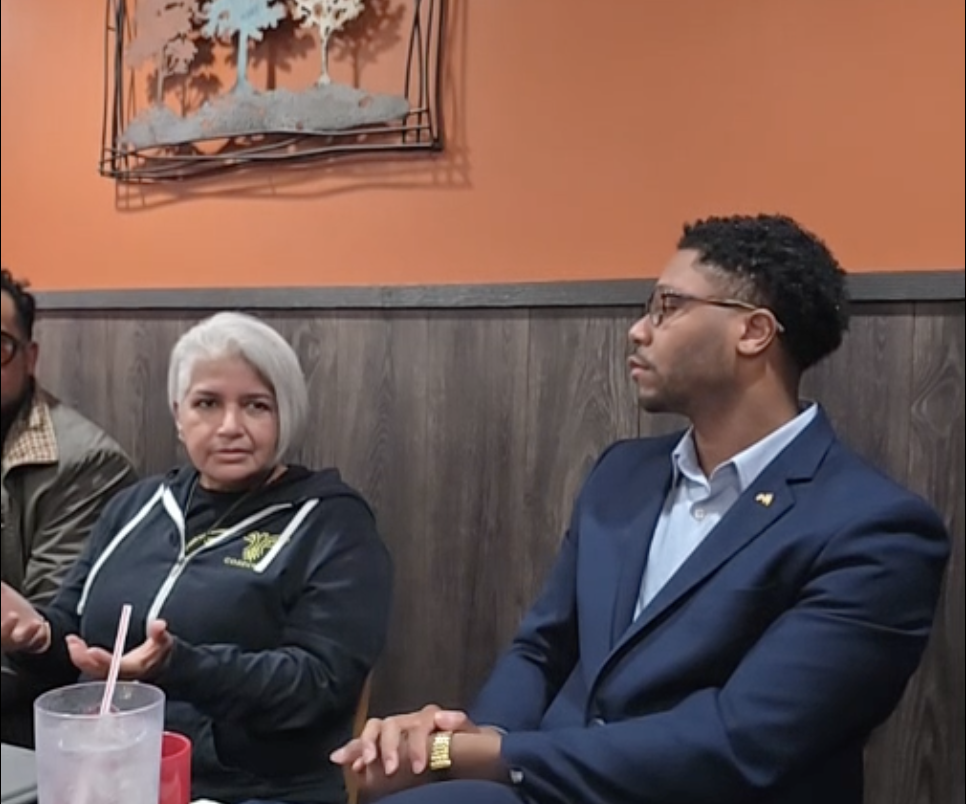
Commissioner Marshall Kilgore pledged support for sanctuary policies opposing Immigration and Customs Enforcement (ICE) in Grand Rapids just two days after immigration activists derailed a City Commission meeting.
Kilgore made his pledge during a Sept. 24 livestreamed dinner with Movimiento Cosecha, a local immigrant rights organization opposing federal immigration enforcement. Also participating were members of the Democratic Socialists of America and GR Rapids Response to ICE.
During the discussion, Kilgore compared the immigration enforcement actions of the federal government to strategies used by Adolf Hitler, and promoted the historical role of boycotts and disruptions in advancing civil rights.
Movimiento Cosecha organizers at the dinner pressed Kilgore to support their proposed “Safety, Privacy, and Dignity for All” ordinance, which includes a set of six sanctuary policies restricting cooperation between Grand Rapids police and ICE. Mayor David LaGrand has repeatedly spoken out against the policy demands, referring to them as “not very well crafted.”
The proposals included prohibiting future agreements under Section 287(g), restricting the sharing of residents’ information with federal immigration authorities and limiting local police involvement in immigration enforcement.
Organizers acknowledged that the city did not have an existing 287(g) agreement but wanted a policy preventing one in the future. They also called for restrictions on automated license plate reader cameras (ALPRs) and measures preventing facilities in the city from being used for immigration detention.
When asked whether he would help introduce the policies, Kilgore agreed.
“The answer is yes,” Kilgore said.
Kilgore said he could not independently introduce the ordinance and would need support from three additional commissioners to advance the proposal. He encouraged the activists to continue to apply pressure to other commissioners to get their support.
“This will not be easy,” he said. “The city manager has a lot of power. At the end of the day, without four commissioners, it will not even come up for discussion.”
Kilgore said he had already discussed automated license plate reader policies with his fellow commissioners.
During the discussion, Kilgore criticized the federal government’s treatment of immigrant communities and compared its actions to Nazi Germany.
“Many things I’m seeing from the current federal administration are reminiscent of Hitler,” Kilgore said.
“It started with words,” he said, referencing the marking of people under Nazi rule and the persecution of LGBTQ individuals.
Kilgore also questioned whether economic consequences would be necessary for Michigan to change its treatment of migrants, pointing to the contributions of immigrant communities to the state’s agricultural industry.
“Should the economy crash so we can continue to be racist? Should Michigan go broke so we can respect immigrants?” Kilgore asked.
Kilgore said he intended to press his fellow commissioners to support the proposed ordinance but acknowledged that securing enough votes would be difficult.
“So the pressure has to now be on,” Kilgore said. “You have one vote. Who will be the next three?”
He noted that Lindsey Perez-Pleischer, currently running for a First Ward seat on the commission, could be an ally in the effort given that her husband is a person of color.
Toward the end of the gathering, a participant acknowledged that the group’s strategies could frustrate city officials. Kilgore responded by defending the role of boycotts and interruptions in the civil rights movement.
“I could not sit here as a commissioner if my community didn’t boycott, if my community didn’t disrupt,” Kilgore said.
He argued that civil rights demonstrations had historically made more privileged communities uncomfortable and were not always popular.
Kilgore also pledged to continue working with organizers on the proposed policies.
“I look forward to being the champion for updating our ordinance,” he said.
The gathering came two days after the Grand Rapids City Commission adjourned its Sept. 22 meeting following two disruptions during public comment. Movimiento Cosecha organizers were among the demonstrators who forced a premature adjournment by chanting slogans and refusing to come to order when asked by the mayor.
Protesters chanted “abolish ICE” and accused the city of cooperating with federal immigration authorities. City Manager Mark Washington directed Police Chief Joe Trigg to intervene, and Trigg warned protesters they could face arrest if they did not come to order.
Mayor David LaGrand ultimately adjourned the meeting in hopes of deescalating the situation.