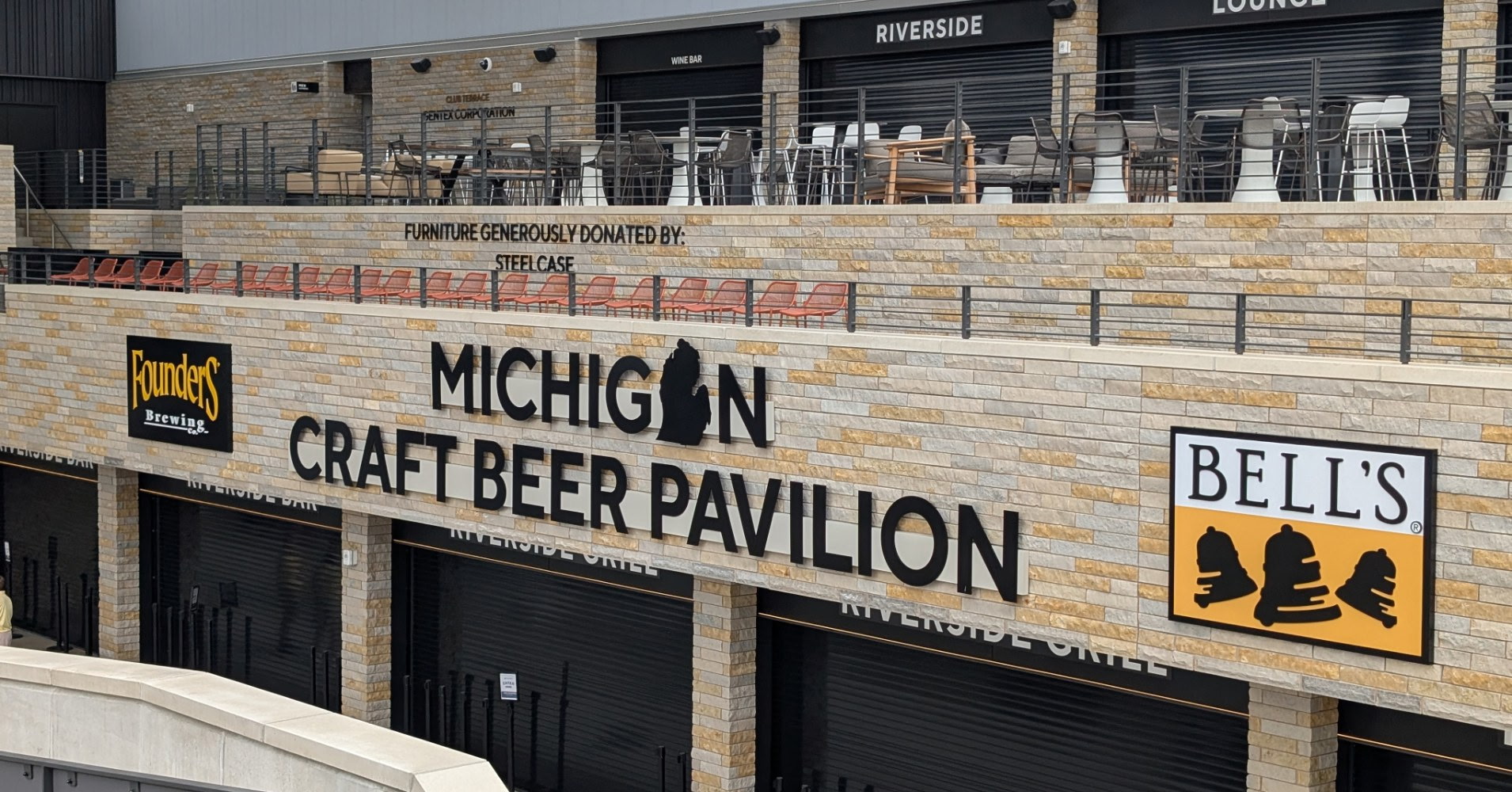
Members of Grand Rapids’ local brewing scene say they are unable to sell their beverages in some of the city’s biggest venues, undermining the reputation of “Beer City USA.”
USA Today in March named Grand Rapids “Beer City USA” for the sixth straight year, beating out cities like Denver, Milwaukee, San Diego, and Pittsburgh. That title acts as a badge of honor for many in the local brewery scene and is a major driver of city tourism.
Several local venues, including the Acrisure Amphitheater, DeVos Place, and Van Andel Arena, cooperate with hospitality company Legends Global to offer food and drinks at events. The partnership, approved by the Grand Rapids-Kent County Convention Arena Authority (CAA), will be extended in July for a period of 15 years.
Venues offer a rotating selection of beer from major national names like Bud, Michelob, Bell’s, and Founders, but don’t include any breweries owned in Grand Rapids. While Founders has a brewing facility based in the city, the brand is now under Spanish brewing conglomerate Mahou San Miguel.
The only locally-owned vendors carried by Legends Global are coffee and liquor brands, according to information provided by a company spokesperson. Several local breweries told The Grand Rapids Herald they believe such arrangements are harming the city’s Beer City reputation.
Jason Spalding, owner of Vivant Brewery, said he has repeatedly tried to find ways to sell his beer at sporting events and concerts in Grand Rapids. Spalding said many national beverage companies have preexisting relationships with hospitality providers, making it difficult for him to make inroads with decision makers.
The process of inking a beverage deal with a venue, he claimed, is highly complicated and has oftentimes resulted in more dead ends than productive talks.
“You just kind of hit these walls,” Spalding said of the negotiating process. “The bigger players have those connections, and it’s just hard to break through.”
Spalding said that by not allowing local brewers to offer their drinks at the city’s most visited venues, the venues are missing an opportunity to capitalize on the reason behind Grand Rapids’ “Beer City” title. The added business would also have a major impact on the local economy, he said.
“It’s just kind of a shame that there’s not a way to show off our city’s beers that are made right here,” he said. “How cool would it be to have an economic driver for money that stays in the community?”
“That could make our entire year, the volume that could go through one of those places could sustain any of us,” he added. “It could be a really big deal for a small company like us.”
Spalding said the issue is made worse by a persistent public perception that Bell’s and Founders are locally owned companies. Even though they each have ties to Grand Rapids, the companies have long since grown beyond their West Michigan origins.
“Bell’s and Founders are breweries I look up to, they’ve done amazing, they’re examples of the American Dream,” Spalding said. “The reality is both of those companies are now owned by international conglomerates. The profits for those beers when you purchase them go not only out of the community, but out of the country.”
“I think there’s a big gap where people either don’t know or it just isn’t in their line of thinking, or because they’re such long-standing Michigan names it’s hard to unravel that,” he added.
Barry VanDyke, co-owner of Harmony Brewing Company, said that while the Beer City name has taken Grand Rapids far, local venues should be doing more to help further elevate that reputation.
“Perhaps we need a renewed effort by some of the larger entertainment institutions in this city to help keep our beer scene vibrant,” he wrote via email. “Places like the Arena and the new Amphitheater sell a lot of beer. It would be huge for some of us smaller breweries to have access to that- not only for the revenue but also for the exposure.”
VanDyke said one major barrier preventing him from selling at the city’s biggest venues is the fact that his is a self-distributing brewery. This means that he sells his products directly to retailers, rather than working with an outside distributor.
He said this arrangement means he loses out on valuable connections made with long-standing distributors, such as those that operate in Grand Rapids’ venue scene.
“Instead of dealing with one or two distributors to bring on all their beer, they would have to deal with individual billing and receiving for just us,” VanDyke said. “I get that, but a lot of the other breweries here in town are carried by the same distributors that bring in the Miller Lite and the Budweiser.”
“Hopefully some of the barriers to getting us all a shot on tap could be addressed,” he added. “I know I am not alone when I say that we could really use the support!”
David Ringler, co-owner of Cedar Springs Brewing and Küsterer Brauhaus, said he has found it difficult to get his foot in the door with large venues given his limited reach as a small business.
“We’ve had some success with a few venues and it’s a great local partnership when it works out, but it is difficult for a local, ‘little guy’ to get their foot in the door and establish a relationship in a large, corporate venue,” he wrote via email.
Ringler too said he wished a different precedent could be set for the nation’s leading beer destination.
“It’s a shame, because ‘Beer City’ often ends up underrepresented in these facilities for the many visitors to our community who come for events,” he said. “Hopefully, we can generate some additional opportunities going forward.”
Legends Global told The Grand Rapids Herald the company is always interested in working with local businesses to bring new offerings to event attendees.
“Van Andel Arena and Acrisure Amphitheater are proud to partner with Michigan and West Michigan businesses to bring a selection of local products to our guests, and these offerings continue to grow and evolve over time,” a spokesperson wrote via email. “Our food & beverage team regularly engages with local vendors and always welcomes the opportunity to explore new partnerships.”
Michigan in 2025 had 410 craft breweries, according to the Brewers Association. At least 29 listed breweries are located in Grand Rapids.