Grand Rapids has seen repeated demonstrations opposing Automatic License Plate Reader (ALPR) cameras such as Flock in recent months, yet most city commissioners are in favor of keeping them.
Mayor David LaGrand had most recently suggested the city could potentially replace Flock with another vendor, though no movement has been made on that front. That topic was again raised during a Thursday workshop session in which the commission debated the merits of ALPR cameras and whether or not to do away with them.
Commissioner Lisa Knight said her constituents have repeatedly expressed concerns over how Flock camera data is shared. She expressed support for limiting the sharing of Flock data with other entities outside of Grand Rapids.
“The conversation around shutting off sharing that data with people who are misusing it and mistreating it across the country is—that’s like a no-brainer, that’s something that we can do,” she said.
Commissioner AliciaMarie Belchak suggested Flock cameras could be used by Immigration and Customs Enforcement (ICE) officials but also acknowledged changing vendors may not be feasible for the city.
“A bigger philosophical question that we need to address on this body is ‘what are the standards that we are going to use when judging this technology?’” she asked. “This goes back to a larger conversation of what is the value versus the risk?”
Commissioner Marshall Kilgore took a harsher stance, saying he is not in favor of any ALPR cameras in the city. He called back to his decision to support a citywide ban on Flock cameras.
“All of these questions and us not having the answers is exactly my concern,” he said. “I am only in support of two things: ending the contract and no longer using ALPRs.”
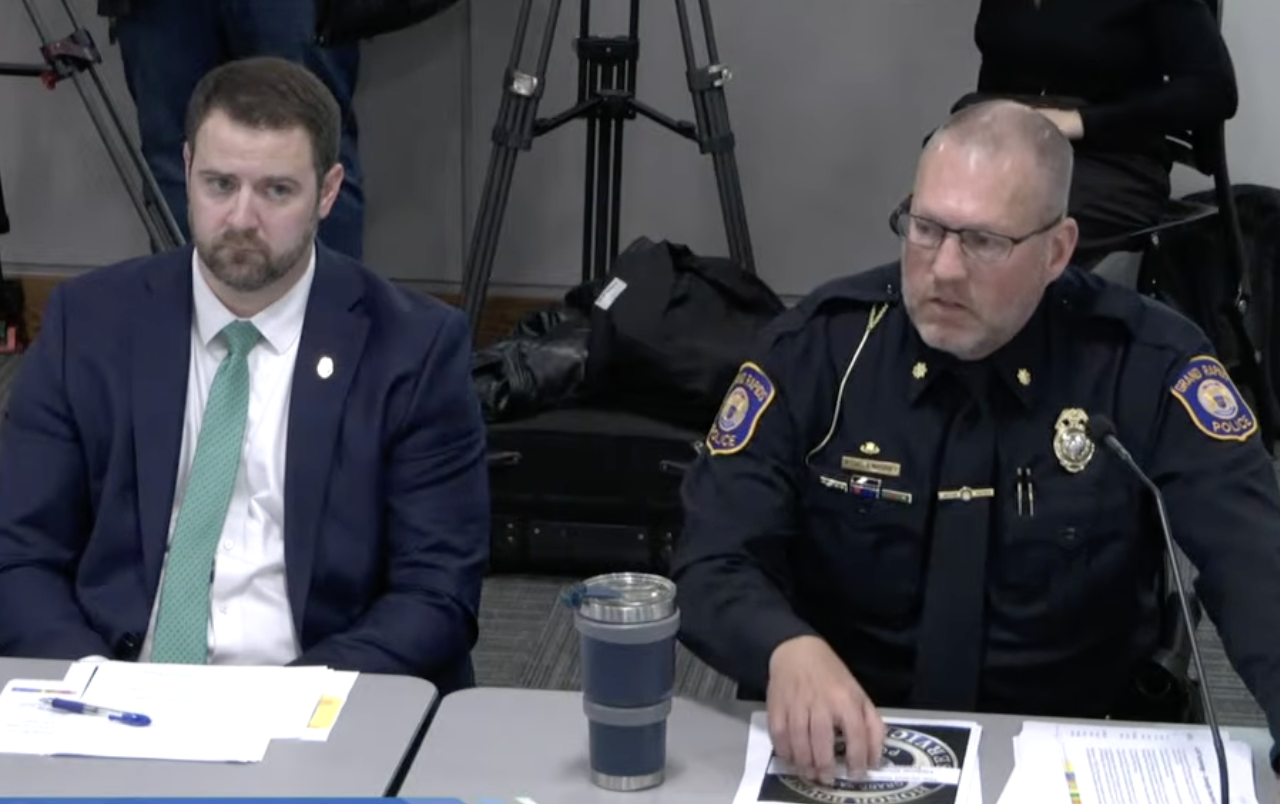
To close that conversation, Deputy Chief Maycroft appealed to the commission by citing his 31 years of policing experience and saying that banning Flock could hamper the police department’s ability to solve violent crime.
“I’ve unfortunately had to deliver bad news in the Third Ward for the majority of my career that I’ve worked as a patrol officer,” he said. “People that are victims of violent crime, shootings, homicides, you name it, and us not being able to bring justice to those victims because we didn’t have the technology, we didn’t have the ability.”
Maycroft said Flock cameras have helped GRPD identify specific vehicles of interest, rather than identifying all vehicles that match a given description. This, he said, allows the department to act quicker to bring criminals to justice.
“This technology has made us extremely more efficient,” he said of Flock. “It’s also helped us bring justice to victims of violent crime in every one of your wards.”
The deputy chief also reflected on the fact that Grand Rapids continues to struggle to confront violent crime and said that taking Flock out of GRPD’s arsenal could cause the issue to worsen.
“To just say ‘get rid of it,’ the unintended consequences are, you’re going to have a whole lot more victimization out there because we don’t have the tools to bring justice to them,” he said.
He also called on members of the city commission to attend ridealongs and meet with detectives to see how Flock is used in the field to assist officers. Maycroft also dismissed the notion that another ALPR vendor could better serve the city.
“Any technology can be misused and we know that,” Maycroft said. “We’ve put in very, very strict protocols in this police department, auditing features, and I doubt you’re going to find another vendor that has that security and has that transparency.”
“I just want people to realize that moving forward, there is unintended consequences, and let’s not forget about the victims of crime in our city because we take a victim-centered approach to these investigations,” he added.
In a survey of Grand Rapids residents released last month, 90% of respondents said Grand Rapids must focus on improving public safety. Mayor David LaGrand suggested the figure was connected to ICE activity in Grand Rapids.
“Obviously that national moment of fear among other things would certainly, to me, contribute to overall feelings of safety in the community,” LaGrand said. “That’s not safety—worrying about ‘can I go for a walk at night?’—but a question of ‘are my neighbors going to be stuffed into the back of a bus some afternoon?’”
Data maintained by the FBI also shows that Grand Rapids consistently outpaces the national average for aggravated assaults. That rate puts Grand Rapids far ahead of other midwest cities with similar population sizes over the same time period, including Des Moines, Fort Wayne, and Madison.
Write to jackson@grherald.com