
Grand Rapids Police Department leadership and Flock Safety representatives defended and explained the city’s use of automatic license plate readers in a Public Safety Committee meeting on Tuesday.
At the presentation’s close, City Manager Mark Washington asked the police department to prepare an annual report, following Grand Rapids’ standard outlined in its 2015 surveillance policy, and said he and the City Attorney’s office would review including ALPRs into that same policy. GRPD is also working with Flock to construct a transparency portal.
The city has 31 cameras currently. After the meeting, Police Chief Joe Trigg said GRPD has no plans to buy any more.
Deputy Chief Mike Maycroft said the technology allows for increased efficiency and less manpower. Following the Great Recession, GRPD staff was cut and has not rebounded to its pre-2008 headcount of about 400 sworn officers.
The meeting was well-attended and lasted for more than two hours, with audience members voicing disagreement at points during the presentation and committee member questions.
Hundreds of crimes and missing person incidents have been solved using evidence obtained by Flock cameras, Maycroft said in his presentation. Among them were finding a homicide suspect in New Mexico in February 2025, locating an elderly man with dementia, and finding a person suspected of assault with intent to murder two weeks ago, as the suspect returned from Muskegon to Grand Rapids.
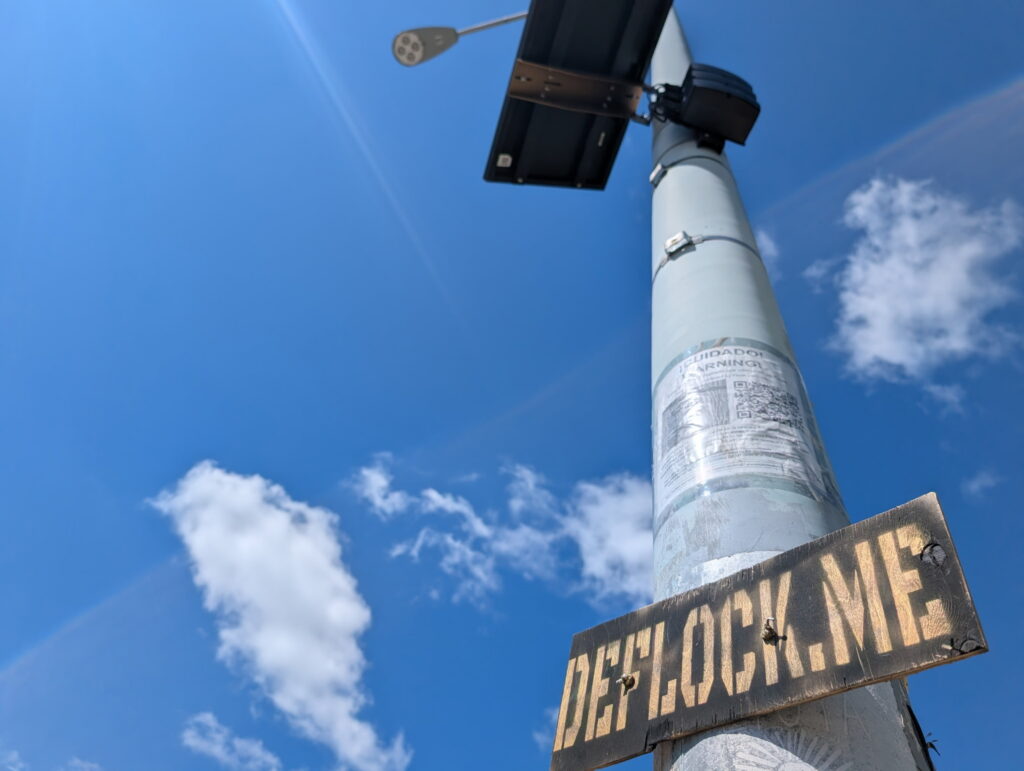
The city has used automated license plate readers since 2012, switched brands in 2020, and switched again to Flock in 2024. Because the surveillance policy was implemented in 2015, ALPRs were not subject to it.
Since 2024, all GRPD searches using the system have been audited by the detective sergeant of the Digital Intelligence Unit.
The city has searches disabled for both civil and criminal immigration cases, as well as cases involving abortion access, said Maycroft. Any agency with access to Grand Rapids’ data is also unable to search these keywords, and the city dictates what cases agencies are allowed to search.
The city owns the data, which is retained for 30 days, after which it cannot be recovered.
Data cannot be sold, said Kerry McCormack, Flock public affairs manager. Flock cameras do not do facial recognition or facial image searches, the feed is not live, and audio data is not collected, Maycroft said.
Maycroft and Trigg likened the technology and the public backlash to drones, which faced criticism when adopted, but have since been used without issue, in comments to media after the meeting.
“I like my privacy as well. I just don’t want the government coming in, no reason, and watching anything and everything I do, so I respect that,” Trigg said. “But I also—almost 26 years on the job—I want the best tools here to have the safest city we can have.”
Committee members said this issue had captured constituent attention like few others. City Commissioner Marshall Kilgore read out a statement from the ACLU of Western Michigan, opposing the city’s use of the technology.
“ALPRs must be strictly monitored and regulated. The city first started using ALPRs as early as 2012, but 14 years later, ALPR and other surveillance technologies have rapidly grown and outpaced the regulations and safeguards that govern them,” Kilgore read.
Civilian Member Jim Davis questioned the Flock representatives on what would guarantee Flock would never contract with federal immigration agencies.
“We’ve been using [ALPRs] for 14 years, and I just want to remind everyone in the audience that 14 years ago, we didn’t have front-facing cameras on phones when selfies were starting. The technology that we agreed to back then has significantly changed,” Davis said.
Civilian Member Andrew Feikema pressed both Flock and GRPD as to whether officers could game search queries to search for immigration-related cases, despite the disabled features.
“This is a big Fourth Amendment concern to me. I think that with all this technology that we have, I prefer that we rely on human judgment and the use of judges, magistrates to be making decisions,” Feikema said.
Before the City Commission meeting later that evening, roughly 10 protesters organized by DSA of Grand Rapids gathered in front of City Hall to protest the ALPR technology. The meeting had nearly three hours of public comment, mostly against the city’s contract with Flock.
Write to juliana@grherald.com