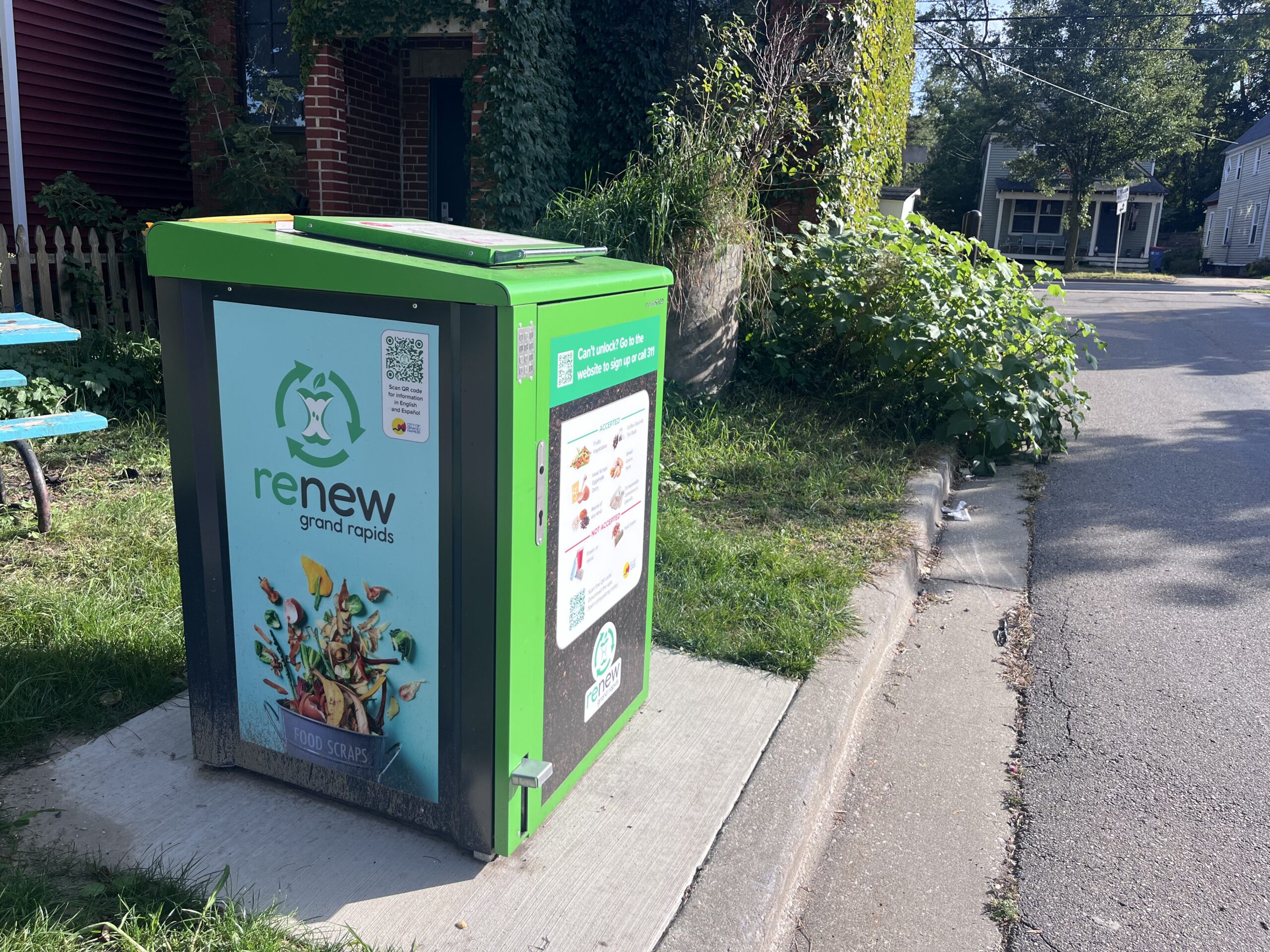
A new city initiative to offer free food scrap drop off for Grand Rapids residents has small private composters nervous. Wormies, a local composter, said it lost some customers to the free service. Wormies and Organicyle, another composting business, are worried that trend will continue.
Between a quarter and a third of the 500 pilot participants of Renew Grand Rapids, the municipal composting service, were recent customers of local composting companies, said Daniel Schoonmaker, executive director of the West Michigan Sustainable Business Forum.
Luis Chen Aguilera, owner of the residential vermicomposting service Wormies, said about 200 customers who have canceled their service have gone to free municipal programs in Grand Rapids, East Grand Rapids, and Kent County since April.
The curbside program offered by East Grand Rapids has brought about the most attrition, Chen Aguilera said.
When they go, Chen Aguilera tells them to let the municipalities know they stopped an existing composting service to join the public one. A city of Grand Rapids spokesperson said two customers have notified the city they left Wormies for its municipal service.
“What I’m concerned with is shifting the demand from a private company that created the demand,” he said.
Wormies charges $16 a month for compost pick up. The city’s seven food scrap drop-off locations are currently free.
“I am hopeful they are going to learn from their pilot, and they are going to prevent any harm to my company, because they seem to want to work together,” Chen Aguilera said.
Dan Tietema is the operator of Organicycle, a Grand Rapids commercial and residential composter which has been in business for 15 years. Although his clientele is mostly commercial, and the city’s pilot is residential, he’s concerned the city will eventually also compete for commercial businesses.
The city of Grand Rapids said it currently has no plans to start a commercial operation and has not submitted bids for a commercial composting facility.
“They are looking to use taxpayer funds to start a business, when there are other small businesses who have spent 15 years using their own resources, time, and money to create a demand, when there was no demand,” Tietema, who is a Third Ward resident, said.
The Grand Rapids Department of Public Works visited the Organicycle composting facility on Aug. 13, 2025, Tietema said. At that time, city officials told Organicycle that it did not want to set up a competing service, but instead expand access to low-income residents who may not be able to afford a private composting service.
Had he known the city would be launching its own residential service, Tietema said he would not have let the city tour his facility. The city, through its spokesperson, said it was invited to tour the facility. Tietema said he did not extend an invitation.
Tietema expressed frustration that Grand Rapids was competing with its small businesses, particularly as Organicycle and Wormies are respectively woman- and minority-owned.
“Do we want a city government that challenges and takes on its private businesses, when the time is right?” said Tietema.
Chen Aguilera said he would like to see the city pursue composting vouchers for low-income residents or purchase compost created by small businesses for city projects, rather than offer an alternative service.
“I would like to have some clarity for what the goals are for all of these municipalities, so we can find our place instead of dealing with uncertainties,” said Chen Aguilera.
The city received a lot of citizen feedback asking for a citywide composting service, said Schoonmaker. He believes everyone involved from the city has good intentions and are responding to constituent demand, but that city sustainability and public works officials need to be clear on how they plan to accomplish that.
Grand Rapids has several private composting companies, which Schoonmaker called some of the best private coverage in the state. The Renew Grand Rapids pilot cost $230,000 for the drop-off boxes and one in-house composting vessel and was funded through the Refuse Fund, according to the spokesperson, who said no additional staff needed to be hired for the pilot.
“Could they have accomplished their near term objectives in a more cost effective way by working with local companies? Certainly,” said Schoonmaker.
Composting and food waste diversion are one of 20 action items in the city’s Climate Action and Adaptation Plan. Organic material is around a third of municipal solid waste generated in Grand Rapids, about 13,000 tons, per a city release.
Both Tietema and Chen Aguilera were skeptical that composting demand was high enough to meet city and state targets. None of the four composting facilities in Kent County are operating at full capacity, Chen Aguilera said.
“There’s a demand from those who are paying for a service for a free service,” Tietema said.
“Can you flip a switch, and then everyone is going to be composting?” Chen Aguilera said. “It has to be gradual.”
The city says if operating at full capacity, the pilot program will only account for .05% of the total food waste, leaving plenty of waste to go around. Grand Rapids doesn’t plan to enter into the curbside collection business, the spokesperson said.
“As a municipal hauler, we have a vested interest in contributing to food waste diversion as it is critical to extending the life of the landfill and reducing the overall costs for transportation and tipping fees,” said a city spokesperson via email.
The pilot is the first municipality-owned and -operated composting service in the state of Michigan, per the city’s press release.
“The success of the city of Grand Rapids’ (pilot) is gonna come down to whether they can bring new people into the practice,” Schoonmaker said. “There is a mutually productive scenario for everyone involved.”
The city spokesperson said Grand Rapids will consider impact on private businesses when assessing the pilot.
Write to juliana@grherald.com