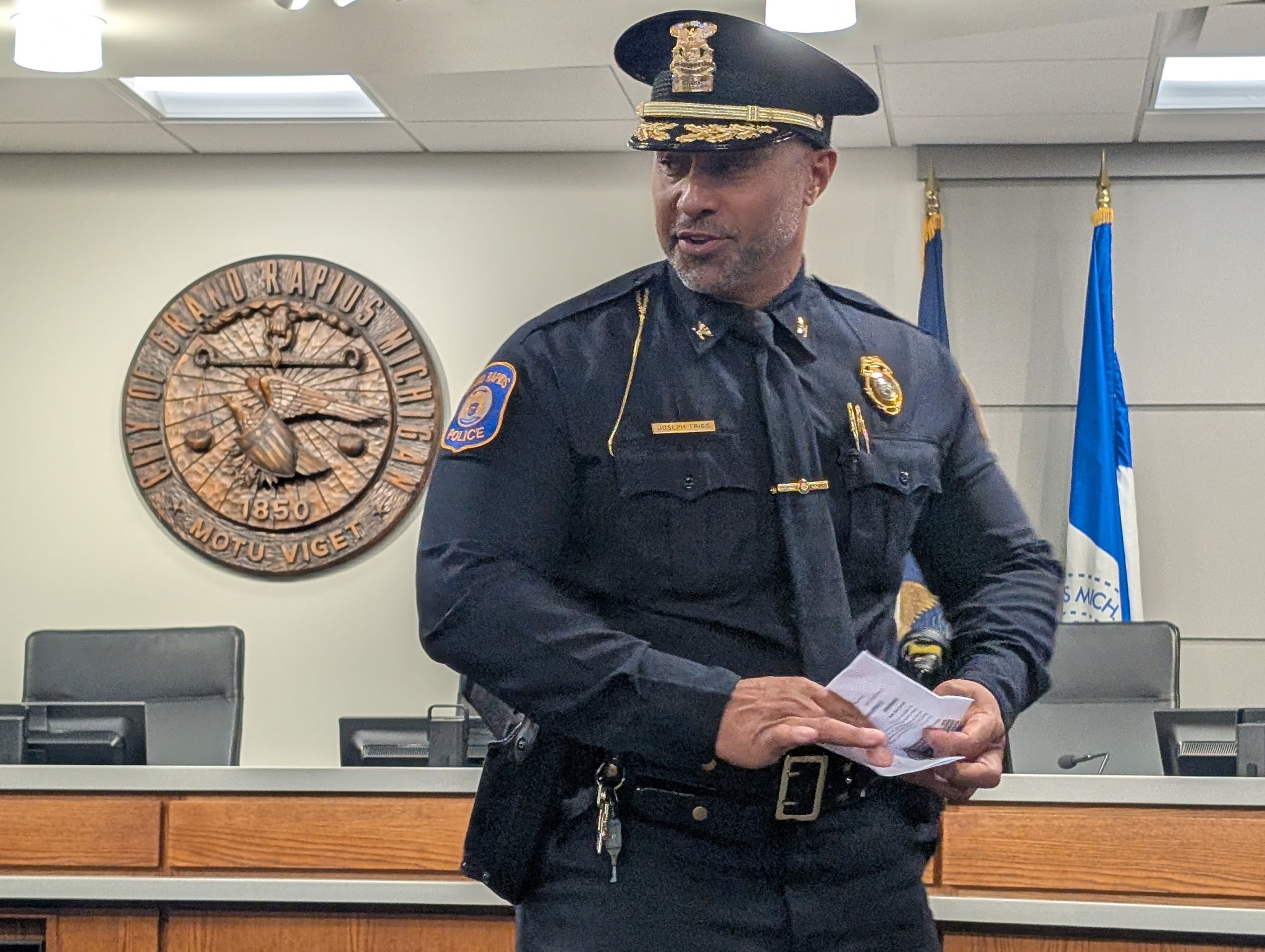
A kid growing up on food stamps, in the shadow of domestic violence and substance abuse, faces long odds to success. Joe Trigg not only avoided the worst but now leads the police department of the second-largest city in the state.
Named Grand Rapids Police Department chief in June, he has served in the interim role since February. His childhood encounters with police inspired him, rather than alienated him from law enforcement.
Trigg spoke at length about his turbulent childhood, his 25-year tenure with the GRPD, and the challenges and plans for the department.
Trigg grew up in the Nelson neighborhood of Muskegon with a single mom. She raised Trigg and his three brothers, the youngest of whom was born with significant mental disabilities. Doctors expected him to die at age 2. Trigg’s brother defied expectations, living until 7, but Trigg suspects his early death was another burden on his mom.
Fueled by alcohol and substance abuse, his home life was volatile. Trigg regularly had to call 911 on his mother’s boyfriend, who was abusive towards her and her children.
“They never responded fast enough when you’re 11. You’re looking out the blinds, waiting for them to pull up to the curb,” he said.
In the most extreme instance, the boyfriend assaulted Trigg’s brother with a bass guitar. His brother fell into a glass coffee table, smashing it. The boyfriend then hit his mother in the head with the guitar and took off, stealing his brother’s car. Trigg watched on from the couch.
Trigg’s mother was in intensive care for about a week. He was 12 years old. His mother continued seeing her abuser for years after.
A Way Out
In his eyes, the police officers who responded to his 911 calls were heroes. His aunt Jan, showing up in her bathrobe in the middle of night to pick him and his brothers up, was another stabilizing force in a difficult time.
His oldest brother joined the U.S. Marine Corps to get out of the house. His next older brother went to prison.
“I was taking that path as well,” Trigg said.
His exit ramp off was a sponsored YMCA card, something his family could have never afforded on their own. Through it, he got involved in sports, baseball and basketball.
Life wasn’t entirely rosy—there was still volatility at home. Sports, Trigg said, gave him a productive outlet for pent-up energy that could go somewhere besides juvenile delinquency. He focused on maintaining at least a 2.0 grade point average to maintain eligibility.
He also outgrew being a 5’3”, 120-pound kid, clearing 6 feet. His mother’s boyfriend no longer could push the then 15-year-old Trigg around.
As a high school sophomore, Trigg moved in with a high school friend, where he didn’t have to worry about making 911 calls or substance abuse. Grand Rapids Community College offered him a scholarship to play baseball, where he was a second-team All-American athlete in the 1996-97 season.
The 1996 GRCC Raiders roster lists Trigg as a 6’4“, 220-pound infielder, as a freshman, before moving to second base as a sophomore. Grand Valley State University recruited Trigg after that, but even Southern Illinois University took notice of the then sophomore’s .410 hitting average and team-high 50 RBI.
Although he entertained going professional, his sights remained on his childhood goal of becoming a police officer.
Encouraged to Promote
Trigg joined the department in 2001 and did 10 years of night patrol in the Belknap neighborhood.
Policing runs in his blood, he said. His uncle, Michigan State Police Trooper Charles B. Stark, was killed in the line of duty while conducting a traffic stop for a drunk driver.
The domestic violence cases stuck with him: battered women, holding screaming children. Each of those calls brought him back to being an 11-year-old, waiting for someone bigger and stronger to get the bad guy out.
“When it’s a child calling 911, it was a flashback. That’s me,” he said. “Until the day I stopped answering 911 calls, I never lost sight of that, and there was never a delay.”
Although GRPD doesn’t have official partners, both he and Officer Robert Kozminski worked in the North Service Area, Kozminski in the Highland Park neighborhood. The two were not only often dispatched together, but formed a friendship outside of work.
Right before the July 8, 2007 shift in which Kozminski was ambushed and killed responding to a domestic disturbance complaint, Trigg called him. Trigg had taken the night off to take his family to a Whitecaps game. The shift was slow, Kozminski told him, and it was really hot out.
Trigg told him they’d see each other the next day. After the game, Trigg watched a comedian that Kozminski had recommended. At the same time, Kozminski was responding to the call which would claim his life.
Trigg’s wife found out the next morning, while working at the Ottawa County Juvenile Detention Center. She ran home and told Trigg. He was in disbelief.
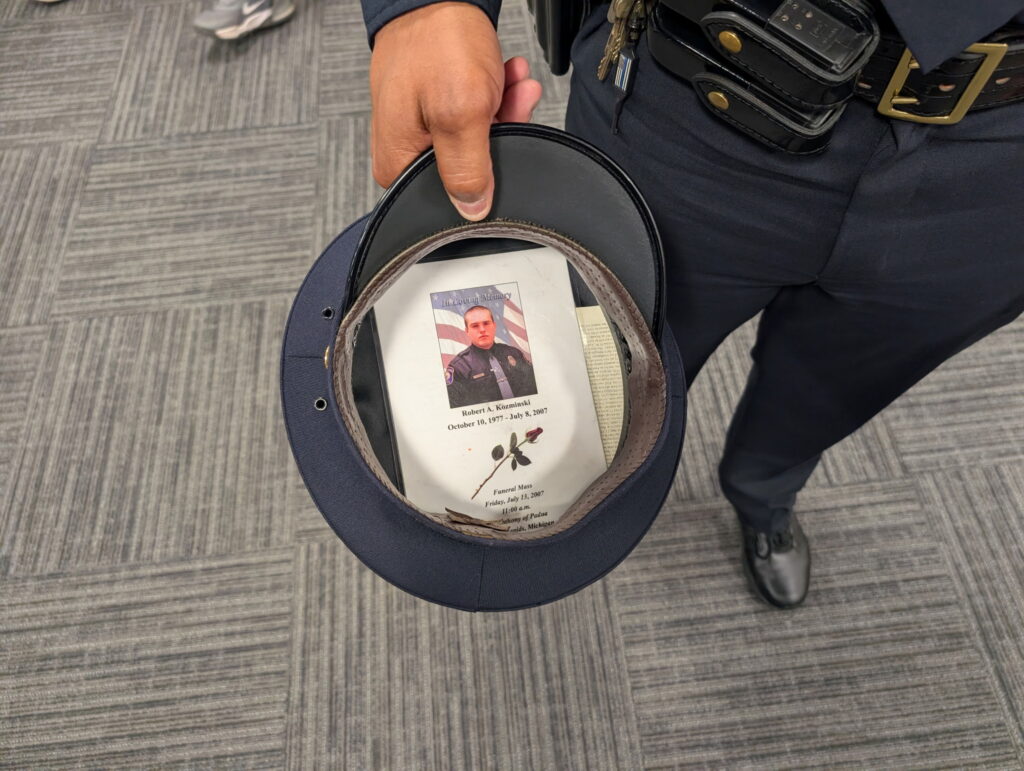
The grief of losing his friend came with guilt. Trigg said he considered leaving the profession and struggled with depression.
Amid this loss, a position to become a community police officer became open.
Around this time, Rodrick Dantzler, a 34-year-old man, murdered seven people in a single day, the bloodiest day in Grand Rapids history. Trigg was driving four or five cars back, as police chased Dantzler on the highway, while he shot at the officers in pursuit. The case, he said, shaped him.
“We had a sea of cars that were pursuing him northbound 131 from 196,” Trigg said. “And (his) back window’s blown out, so he’s just turning and sending rounds downrange.”
“You were not thinking about your wellbeing at that time. All you care about is get this guy off the streets,” he said.
During his nearly three years in community policing, a captain repeatedly urged Trigg to promote.
He did so, reluctantly. Trigg and his former bosses describe him as uninterested in climbing the professional ladder. From 2014-16, he worked the night shift again as a patrol sergeant. The same captain encouraged Trigg to test for lieutenant. Among a handful of officers who passed the test, Trigg was selected. He was uneasy about the promotion.
“I felt like I stole someone’s parking spot,” Trigg said.
From lieutenant, he became watch commander, the person tasked with running an entire patrol shift.
After three years in that role, then-Chief Eric Payne nudged Trigg to “learn the other side of the house” through an opening for commander of internal affairs. It would be Trigg’s first experience in a police administration role.
Informally known as the “police of the police,” the job is not sought after, Trigg said. His tenure was during 2019 through 2022, during the nationwide protests and unrest following the murder of George Floyd.
“It was tough, tough mentally to see your profession being attacked. They’re calling you evil, knowing that I got into it for the right reasons, noble reasons, with integrity and honor,” he said. “And they’re telling me I’m a killer.”
And again, Trigg was encouraged to apply for captain, again during Payne’s tenure as chief. He refused for over a year, but relented, tested and started in January of 2022, as the captain of the South Service Area.
Three months later, Eric Winstrom started as chief, and a month after that, Patrick Loyoya was shot and killed by GRPD officer Christopher Schurr. Trigg and Winstrom went to a lot of community events. The case ended in a mistrial, after a jury was unable to reach a verdict in the charge of second-degree murder for Schurr.
People were understandably angry, Trigg said, particularly in his service area, where there is a high percentage of people of color. Those meetings were a necessary sounding board for community members whose relationship with police was strained.
Under Winstrom’s tenure, Trigg was named deputy chief. Winstrom was the right boss for the right time, Trigg said, and his hiring, as well as time passing, has allowed the department to rebound from the lowest levels of staffing of about 266 officers, back to around 300 officers.
“For Now”
The reaction to Trigg’s hiring has been overwhelmingly positive. The comment sections of local TV stations describe him as the right guy for the job and cheer on hiring someone who’s worked in the city for more than two decades. Within the department, there’s a similar positivity. Commissioners too have touted positive working relationships with Trigg, as has the Office of Public Accountability, Grand Rapids’ civilian oversight of police.
But honeymoons are short. Trigg himself, when asked about the post-hiring glow, responded with, “For now.”
Protesters are a semi-regular part of city commission meetings. Trigg said they’re not representative of the communities GRPD serves, even those with the highest levels of crime.
“You have clear groups that are organizing to say, ‘We hate the police. We hate the police. Defund the police.’ This and that. But our men and women are going to 300 calls a day, and they are going to some of these neighborhoods that have no one else, just like when I was a younger boy,” Trigg said. “You have no other resources but to call 911, and they are positive interactions.”
As interim chief, Trigg responded to one GRPD officer-involved shooting and was at the helm for another.
As permanent chief, video of an officer punching a 21-year-old man, who refused to provide name and identification and exit the passenger seat of a car after a traffic stop, went viral. Critics called the punching excessive force, but Trigg defended the officer’s tactics as appropriate at first glance to local media outlets.
That drew even more criticism. Trigg called both the praise and the critique distractions. He’s looking forward to getting his face out of the news, an uncomfortable feature of the last month.
“They love you. They hate you. You’re right here doing what’s right,” Trigg said. “Not doing anything for praise or hate, just do what’s right.”
Staffing up the department back to its pre-recession levels remains a priority. When he joined the GRPD, the department had 396 sworn officers. The city of Grand Rapids cut that number by a quarter during 2009 budget cuts. Since then, the challenges have grown with a smaller force, Trigg said.
There are more illegal guns on the streets since the COVID-19 pandemic, and responding to any call with a firearm requires more officers. The new Acrisure Amphitheater, the coming soccer stadium, all require officers to manage traffic. Rebuilding the community policing program, which dissolved into the patrol roster during the lowest points, takes more staffing.
Currently, GRPD is authorized up to 312 sworn officers and with its new class, will be about six officers shy of that limit. Trigg said as the department reaches its authorization, the city hall will bump that number to 322.
Ideally, he’d like to get to 350 sworn officers before he’s done.
“I feel like we have the support of city hall and the commission that that’s needed,” Trigg said.
An earlier draft of this story mistakenly referred to Officer Robert Kozminski as Ken. The Grand Rapids Herald regrets the error.
Write to juliana@grherald.com