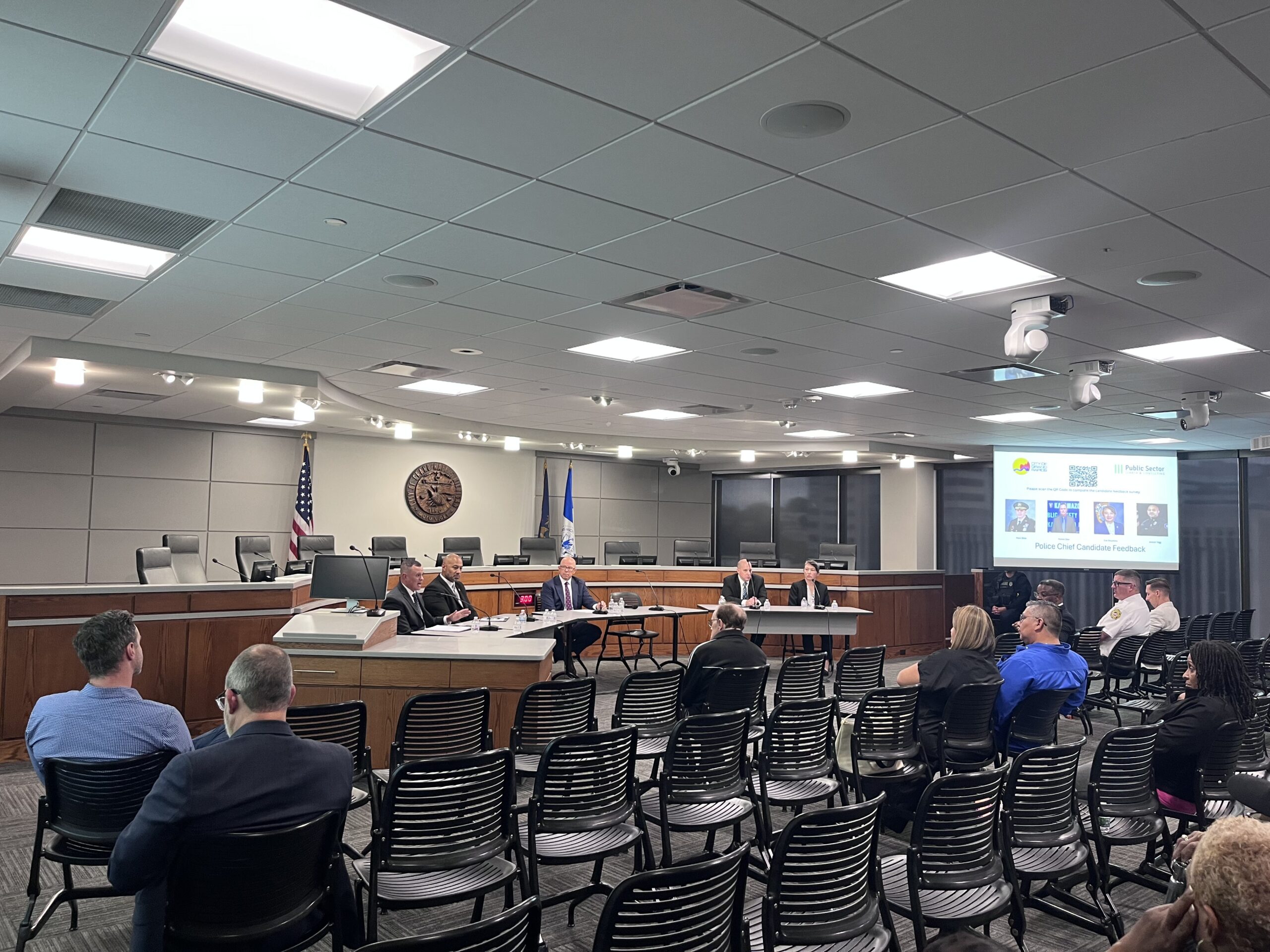
The four finalists for the next chief of the Grand Rapids Police Department touted their experience and vision at a public meeting Tuesday evening.
Gary Peterson, the president and CEO of Public Sector Search & Consulting, moderated a discussion with the candidates: Mark Bliss of the Detroit Police Department; Rafael Diaz of the Kalamazoo Police Department; Eve Stephens formerly chief of the University of Texas at Austin Police Department; and Joe Trigg, current interim chief of GRPD. Peterson asked about officer recruitment and retention, transparency in dealing with officer misconduct, and proactively building community trust.
Prior to the panel discussion, members of the community had the opportunity to speak with candidates directly. Community members asked questions about the use of mental health professionals, candidates’ opinions on community policing, and gun violence.
City Manager Mark Washington said he will interview the finalists personally on Thursday. The candidates also had a two-hour tour of the city before the meet-and-greet sessions. Attendees had the opportunity to submit feedback via a QR code, which the manager said he would review prior to interviews.
Eve Stephens formerly served as chief of police for the University of Texas and is a retired commander from the Austin Police Department. Raised in a military household, she said meeting a police officer at a career day in middle school convinced her to join the police. GRPD’s strategic plan and its values attracted her to the department.
“This is about engagement with the community, and making sure that the police are the community and the community are the police,” she said. “That we are not seen as two different entities that are butting heads against each other.”
In Austin, Texas, Stephens worked with a program that partnered officers with academics both to discuss new innovations in public safety and to conduct research on best practices in policing. She raised the possibility of having an independent mediator broker conversations between police and communities where there’s historically been distrust.
“The preliminary evidence shows that, yes, when people leave these mediated conversations that they actually feel a little bit more trusting of the other party,” she said.
Trigg has more than 25 years of law enforcement experience at GRPD, across patrol, internal affairs, captain, and deputy chief of patrol operations. He grew up with a single mother and had to call the police for domestic violence when he was 11 years old. These experiences set him on the path to join GRPD.
Finalists in $28K Search for GRPD Chief Include Three Michiganders
“I always respected the men and women that when I called, they came to the rescue. I never lost sight of wanting to do this job,” Trigg said.
Trigg said he was involved in bringing back the community officer program back and wanted to expand the program further so officers get to know the community. He touted both his record of accountability, stating that he had terminated officers who violated department policies, and his care for officers.
“We don’t have an anti-police community,” Trigg said. “We have those in our community who have feelings about the police, or maybe are anti-police, but that’s not our community. I would not have the positive attitude for this job and this profession throughout my time, with thinking that we had a community that didn’t appreciate our men and women.”
Bliss currently serves as deputy chief for the Detroit Police Department. Bliss was previously a finalist for a police chief job in Olympia, Wash., in 2022. In his first 100 days, he said he would not only try to gather feedback from stakeholders, but also audit the department, so that it’s obvious how money is spent and what resources the department has.
“Being part of the Detroit Police department has been a blessing, and one of the reasons why: it’s diverse. The department’s diverse. We love our community, and the community loves us,” he said.
Bliss said he would build a roadmap of milestones the department should hit. He said he embraces “full accountability” to combat corruption and potential abuses of power. Police departments should regularly review body camera footage. The department has to be proactive in building relationships with community members, so when a controversial incident happens, there’s already credibility, Bliss said.
“Policing is a sacred duty. Only a few can do it,” he said.
Diaz is a licensed Michigan attorney and current police captain for the Kalamazoo Police Department. Grand Rapids is a vibrant community, he said, and he highlighted how the department has had increased staffing as police forces nationwide have struggled to recruit officers. Field training officers should have to spend two weeks as community police officers to learn their beats before they start with enforcement.
“Every officer is a community police officer, but we have to give them that charge. We have to demonstrate to them that that is important,” he said.
Building community trust with the police department helps with retention and recruitment, he said. When potential applicants feel supported by their peers, people want to join the department, Diaz said. He emphasized the need for an independent, professional standards unit, empowered to investigate any instances of misconduct.
“I take integrity issues very seriously, ” Diaz said. “Because either we’re all doing a good job for the right reasons, and we can build an organization that the community can trust, or we’re eroding it. And I will not allow that to be eroded. There’s too many people that count on the quality of service, the integrity of the officers that are out there.”
Someone in attendance, who said he had been previously arrested and found not guilty, asked how the candidates would handle looking into his arrest. Trigg said the individual should seek accountability through the civil courts. Bliss stressed the importance of a civilian oversight board in these circumstances. Stephens expressed an apology that the man experienced this. Diaz declined to respond.
Grand Rapids contracted with Public Sector Search & Consulting for $28,500 for chief recruitment. Washington said the city chose the four finalists out of eight semifinalists, which the consulting firm provided out of the larger pool of applicants.