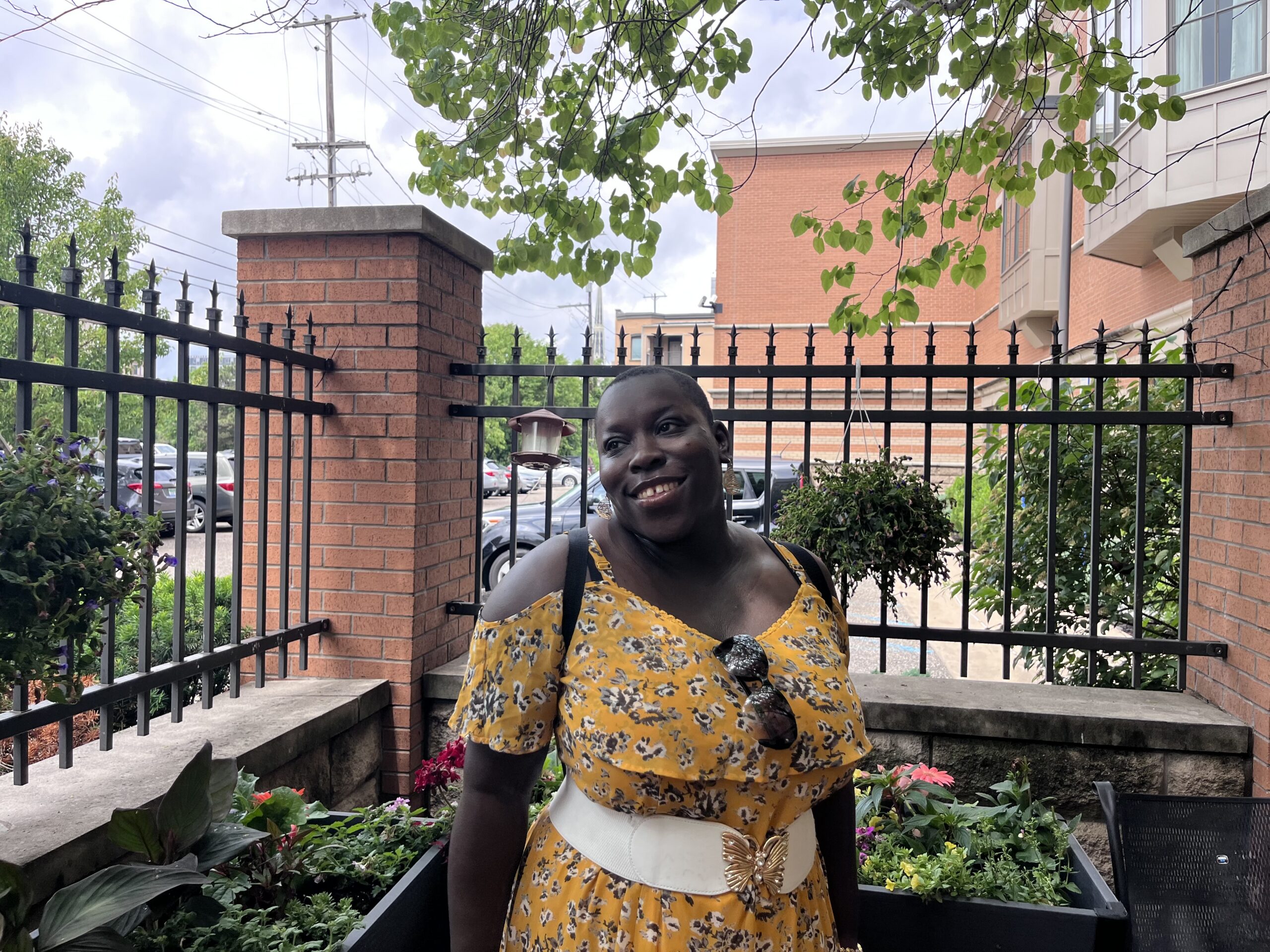
After staying in a shelter, Lilly Frazier found her new apartment lonely.
Gone were the routine and the women who helped her pick out clothes. She was grateful for a home, but daunted by the change.
“It’s night and day, because you go from schedule, people, food being provided for you to being on your own,” Frazier said.
Frazier credited her housing stabilization case manager, Candace Lawrence, for helping her adjust. Lawrence arranged transportation to work and doctor’s appointments. She helped her find small appliances and toiletries.
Lawrence is among six housing stabilization case managers, newly created jobs meant to insure that individuals who move off the streets and into housing stay housed.
These roles are one of the outcomes of the Downtown Pathways Project (DPP), a partnership between nonprofit organizations, local government agencies, and private groups to make chronic homelessness functionally zero in Grand Rapids. And according to multiple people in the project, the new case managers have been critical in keeping formerly homeless people housed.
“The missing middle was case management,” said Megan Erskine, Catherine’s Health Center chief executive officer.
Under 100 in 100, an initiative to house 100 homeless people in 100 days, and DPP, the rate of those who relapse back into homelessness is around 7%, lower than the national averages which are about 16%, according to Thelma Ensink, executive director of Dégagé Ministries.
The DPP launched in March of this year. The goal was ambitious. It took longer than 100 days to house 100 individuals, but by the time of the DPP started, more people were housed than the original goal.
Led by the Grand Rapids Coalition to End Homelessness, partners include the City of Grand Rapids, Kent County, Dégagé Ministries, Mel Trotter Ministries, Network 180, Catherine’s Health Center, and many more nonprofits, as well as a number of private businesses and family foundations.
Functional zero chronic homelessness means the rate of individuals being housed is faster than the rate of their ending up on the street.
“We’re recognizing as a group that this is a really special moment, and that we have a sense of urgency. If we don’t strike at this moment, this moment might pass, and that would be a real loss for this community,” said Ensink.
The individuals targeted in this housing effort are among the most acutely needy and vulnerable. Many chronically homeless people have substance and mental health issues. It’s not merely a matter of getting a roof over their head.
“This work is hard, because homelessness is complex. Mental health is complex. Substance abuse is complex. Keeping a vibrant city in the midst of every urban core in the country struggling with something is hard,” said Josh Lunger, vice president of government affairs for the Grand Rapids Chamber.
Bottlenecks and barriers
Rather than secure new funding streams, partners worked to make sense of the complicated web of existing funding from federal, state, and private sources. The DPP funded the housing stabilization case manager positions through Kent County liquor taxes. Network 180 found this funding, which is set aside for substance abuse issues.
The project hopes to avoid creating an additional nonprofit entity, instead looking to streamline processes between existing organizations.
“You can have all the resources in the world, and if they’re not connected, it doesn’t matter,” said Erskine.
The nonprofits worked together to compile a list of the roughly 190 chronically homeless persons in Grand Rapids by name and secured release forms. Now, entities like Catherine’s and Dégagé, regularly sit down and coordinate care. The nonprofits have a secure Microsoft Teams channel where they can talk about clients in real time.
The DPP has identified a number of bureaucratic hurdles. The Michigan State Housing Development Authority previously had important documents mailed to clients seeking housing, a stumbling block for those living on the streets. These documents will soon be available online.
There were also regulatory requirements around unit lighting for housing-choice vouchers that kept a number of apartments from qualifying, Ensink said. The DPP worked with the Grand Rapids Housing Commission to pass new regulations and make more homes eligible.
The DPP has also arranged funds for a fair market housing study to appeal the current voucher rate. The last study was prior to Grand Rapids’ housing boom, and the vouchers are insufficient to cover rising rents.
Additionally, the DPP centralized flexible funds from nonprofits so that a larger expense like a security deposit won’t deter someone from getting housing.
“The thought process of someone being outside for an extra week because of $250 drives me nuts…” said Lunger. “It’s insanely cheap for the outcomes it helps provide.”
Learning to live
Heartside Landings opened in spring 2024. The 25 women who live in the transitional housing facility had dramatically improved outcomes. Ensink said there was a 91% reduction in emergency room visits and a 93% reduction in emergency medical services among the residents.
Heartside Landings offers around-the-clock assistance, and Catherine’s is onsite for both physical and mental healthcare.
“You can’t just house people with healthcare needs, mental health needs, and expect them to be okay,” said Erskine.
Lawrence has a case load of around 20 individuals. Her clients often have to start from scratch, learning to shower, set boundaries around guests, and clean their apartments. She starts her day by looking at client data, and then she goes out.
“Some of the people that I work with, they’ve been unhoused for 10-15 years. They can’t recall how to properly wash dishes or make their bed…” said Lawrence.“These people are used to living on the streets. They’re used to survival mode.”
One woman had slept in a tent in the woods prior to moving into Heartside Landings. To get used to the new apartment, Lawrence set up a tent in her room and over time disassembled it.
“I 120% believe that homelessness is solvable, but it takes the community,” Lawrence said.
Cross-sector understanding
The issue of homelessness in Grand Rapids has at times been a point of contention between the nonprofit and business communities. The DPP has provided an opportunity for the two parties to stand in each others’ shoes.
Business community members said they recognized the tireless work of the nonprofits, and the nonprofit partners said they realized how homeless people sleeping or aggressively panhandling may impact businesses.
“I want to live in a vibrant city, and I also want people who have structural disadvantages to have a pathway to dignity,” said Erskine.
The model is unique to Grand Rapids. All three of the DPP member groups said they hope the city can become a model for other cities.
“Downtown Pathways and 100 in 100 is the blueprint for how our community needs to move forward,” said Erskine.
Write to juliana@grherald.com