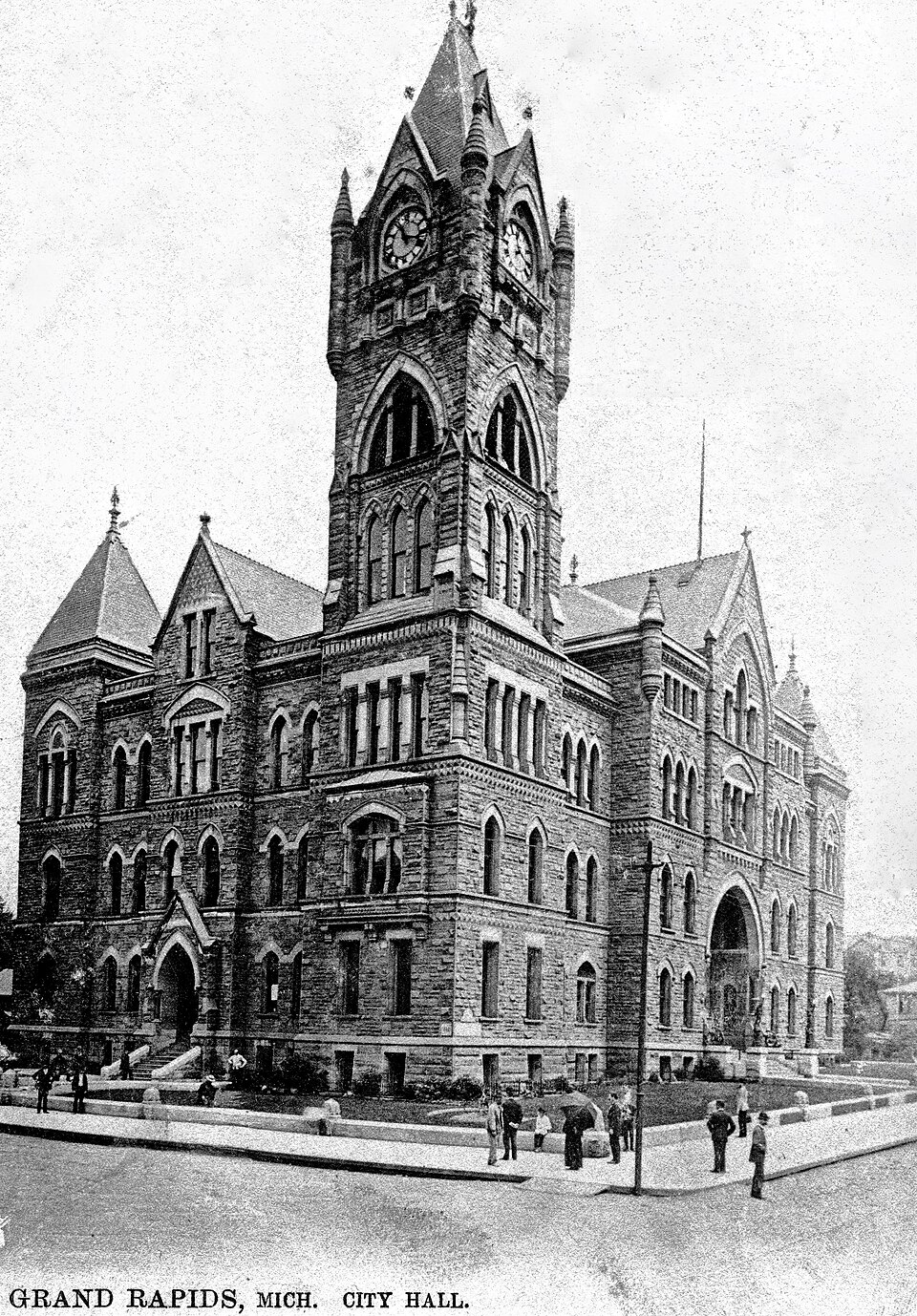
Grand Rapids’ historic city hall was razed to the ground in the 1960s during the national urban renewal movement.
The city’s current administrative building resides in Calder Plaza, the same site of Grand Rapids’ iconic red “La Grande Vitesse” statue. The previous building, constructed in 1888, had once occupied nearby land at the corner of Lyon and Ottawa streets where the Kent County Court House now sits.
That former Gothic-revival city hall was made of sandstone and featured a tall clock tower with peaked roofs. All that remains of that structure today are its four clock faces, which still keep time outside the court house, and the original bells reside in the Grand Rapids Public Museum.
The Building
Construction on the original city hall building began in May 1885 with a construction contract of $185,641.68. It was within eyeshot of the home of Henry Williams, the city’s first mayor, according to archival information from the Grand Rapids Historical commission.
Elijah Meyers, the same architect who designed the Michigan State Capitol Building in Lansing, designed the building. Its exterior featured a “six story corner tower with belfry and clock,” a “hipped roof with gables over the central pavilions,” and “pyramidal roofs over corner pavilions” with “arched windows,” according to the Library of Congress.
Inside, the building featured “rich modified Gothic interior detail” with “ornamental tile floors.” The building looked east, toward the “original Swedenborgian Church,” the Historical Commission writes.
The Destruction
Although the building was enshrined in the National Register of Historic Places in 1969, it would be demolished that same year.
Residents attempted to save the building, but their efforts were in vain. A 1967 Grand Rapids Press editorial, titled “High Cost of a Relic,” wrote that the city had sold a portion of the property to Union Bank & Trust Co. for $114,000. Additionally, Grand Rapids had contracted with the federal government for a downtown renewal project, which included $376,000 for the city hall building and property. Reneging on that sale and those credits would force the city to pay back the nearly $500,000, worth about $5 million today.
The editorial argued that even after paying that sum, the city would be on the hook for renovating city hall. It’s possible the building had fallen into disrepair over its 81-year lifespan and had once been condemned by fire inspectors, MLive reported.
The day prior to the official vote, Grand Rapids commissioners held a secret meeting on demolition, according to Grand Rapids Press archives. Closed to the public and media, the clandestine meeting was supposedly about the use of undercover police officers.
When demolition day came on Oct. 27, 1969, Grand Rapidian Mary Stiles, who had campaigned against the building’s destruction, handcuffed herself to the wrecking ball. Her husband, John Stiles, agreed to unlock her, but only after cameras recorded her being lifted up on the wrecking ball, according to Grand Rapids Press archives.
Several buildings in the city were demolished during this time, including a library, a theater, and a “Monroe Center” building, according to records from the Grand Rapids History Center.
Preservation
While the city now meets inside a modern glass tower building, many remain furious over the decision to raze the old city hall. Several online comment threads by Grand Rapidians refer to the demolition as a tragedy and an ongoing source of shame for the city.
A strong historical preservation mindset now thrives throughout Grand Rapids. Heritage Hill, an area defined by its 19th and 20th century houses, is now under the protection of local, state, and federal government prohibitions against demolition or other detrimental developments.
A city historical preservation ordinance has protected some six local historic districts and 70 landmarks since 1971. Since adopting the ordinance, Grand Rapids has nominated 55 structures to the National Register of Historic Places, including about 2,000 properties.
Write to jackson@grherald.com.