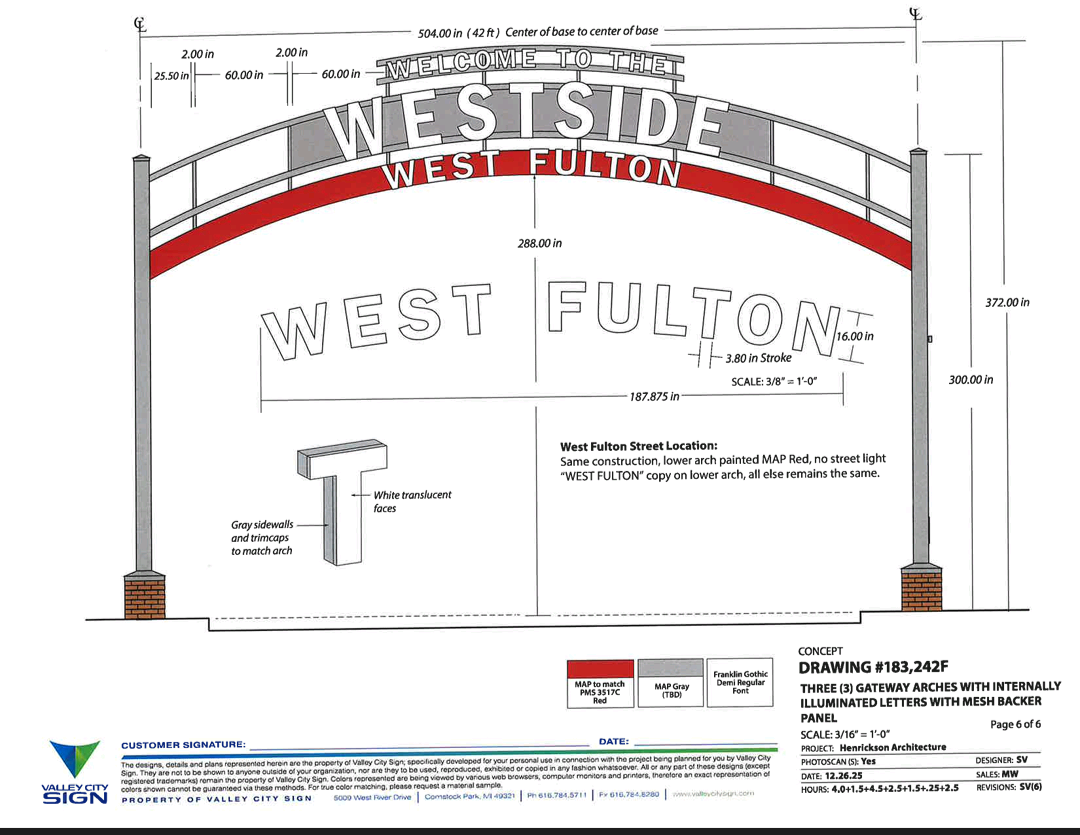
Community leaders are pushing back after the City of Grand Rapids announced it would commit up to $1.7 million to build three light-up signs across the city’s West Side.
The development, dubbed the Gateway Signage Project, will install arches marking the West Side’s “primary business districts” on Stockbridge, West Fulton, and Leonard streets. That project is intended to advance the city’s “beautification and placemaking goals” and is expected to be completed next spring.
A city spokesperson told The Grand Rapids Herald the project was awarded to J. Rank Electric through a “competitive bid process,” though only one company applied for the job.
To fund the project, the city is using Tax Increment Funding (TIF), an economic tool that subsidizes new developments with money generated through property tax increases.
“It is important to clarify that the $1.7 million is not an added cost to Grand Rapids taxpayers,” the spokesperson wrote via email. “This approach ensures that the financial responsibility for district upgrades remains localized and that the benefits of growth within the corridor are reinvested directly back into the community through placemaking, infrastructure, and business‑district enhancements.”
Part of the $1.7 million expense is a roughly $300,000 expedited contingency expense, which is intended to incentivize construction to complete prior to the opening of the Amway Soccer Stadium.
Leading the project is the city’s West Side Corridor Improvement Authority, which cooperated with the West Grand Neighborhood Organization (WGNO) among other groups to plan the project. Seth Moore, a WGNO board member, spoke to The Herald in his personal capacity and said he had several misgivings about the project from its inception.
“While I personally think that the arches are cool, do I think that now is the right time and do I think that this is the best use of taxpayer funding?” Moore asked. “We as a community have, in my personal opinion, a lot of other needs that are a lot more important than arches.”
“I’m sure it might bring some additional business money to businesses in those corridors maybe, but $1.7 million just seems like maybe something not well thought out,” he added.
Moore said he would rather see those funds be used to combat homelessness, an issue that is on the rise in Grand Rapids. He also said such a large sum generated from local tax dollars should be raised to a vote.
“I’m not happy with this,” he said of the project. “I don’t think this is an appropriate use. I don’t.”
Annette Vandenberg, the executive director and CEO of West Grand Neighborhood Organization, told The Herald her group is aware of broader pushback from local business owners who do not want the city to spend such a large sum on the signs. She said that while WGNO was given advanced notice of the project, it was not asked to vote to approve it or its budget.
“We understand why residents may have questions about a $1.7 million investment, particularly when our neighborhoods continue to experience challenges involving housing affordability, infrastructure, public safety, and access to resources,” she wrote in an email. “The announced amount covers three gateway installations, rather than a single arch. We believe transparency about those costs is important for helping the public understand the investment.”
Former WGNO Vice President Lucas Leverett said he too was wary of the project from the time he learned of the high price tage associated with it.
“From the beginning until I learned about the cost, I had been very supportive, but spending nearly $2M on this project is ridiculous,” he wrote via email. “These didn’t appear to be anything more than, maybe, $150-250K apiece in my estimation, and that’s with over 25 years in marketing and advertising, and knowing what signs cost from many years in retail and corporate.”
“That lower amount would have been a fine use of funds,” he added. “This higher amount seems like a boondoggle, a slush fund for contractors getting deals from their pals in the city apparatus.”
Steve Tibbe, who is running for a First Ward commission seat, sits on the West Side Corridor Improvement Authority. Tibbe said he had originally raised concerns about the high budget for the project.
“I believe about five years ago the initial budget was about $600,000 for the three arches and even then, I raised my hand as just a community member and said ‘is this the best use of this money?’” he said. “Fast forward to this year and I get appointed to the board… and the budget had ballooned to $1.1 million.”
After asking more questions, Tibbe said the budget grew again to its current $1.7 million figure. He ended up voting in favor of the project so as not to stifle the progress that had been made before he joined the board.
“I was one of the only board members to question these budgets,” he said. “I did vote yes, but I just didn’t want to rock the boat.”
Tibbe said he also feels the money could be used more responsibly.
“I questioned it and now that we’re at $1.7 million, it does seem super foolish with all the other issues going on in the city,” he said. “I think it’s stupid.”
Commissioner AliciaMarie Belchak, who also sits on the West Side Corridor Improvement Authority, told The Herald she is in favor of the development as a way to welcome visitors into high traffic business areas and may even come in under budget.
“While the contractor bid estimate came in approximately $300K higher than expected at $1.2M, the CIA board felt it was important and timely to continue moving forward with installation this fall rather than next year so we can capitalize on the grand opening of the soccer stadium and properly welcome people to the Westside during the inaugural season,” she wrote via text.
“However, it is the expectation of the board that the construction team should meet the $1.2M bid and not necessarily need the extra contingency funds,” she added. “The CIA has been planning for and saving up for those major project expenses for several years, and it is comfortably allocated within the current fiscal year.”
Write to jackson@grherald.com