Grand Rapids Police Department said it is open to recommendations given by the Office of Public Accountability, including bilingual warnings, but differed with its recommendation for supervisor approval prior to deployment.
Deputy Chief P.J. Baker presented the department’s response to recommendations at a Tuesday public safety committee meeting.
“There are certainly things we can learn from those recommendations,” Baker said.
“I believe we have a good canine policy,” Baker said at a later point. “We have a strong canine team. Our team is good, because we select good people for that team.”
The OPA report in May found that GRPD was following best practices, but lacked written policies for many of the recommendations given. Baker went point by point through the nine recommendations, which included classifying K-9 apprehension as a use of force; narrowing the use of K-9s to serious felonies, not just flight; creating protections for vulnerable groups; expanding public reporting; standardizing the warning language used; requiring a supervisor’s approval before deployment; mandating review of any bites by the Internal Affairs Unit; specifying that GRPD uses “bite-and-hold” techniques; and including demographic data in reporting K-9 apprehensions.
The department could act on the recommendations to provide multilingual K-9 warnings, Baker said. One of the newest handlers is bilingual, and Baker said handlers could receive additional training. The MOP requires officers to make verbal warnings prior to deploying K-9s, unless there is a safety concern, where a warning would risk the officer getting ambushed.
Most K-9 deployments do not require supervisor approval. Those which do are non-serious offenses, where if no danger is present, police dog deployment is prohibited, and certain special circumstances. Commissioner Milinda Ysasi asked Baker to clarify those situations following the presentation.
That recommendation was the lone point of difference between GRPD and OPA. Both agencies stressed the positive working relationship during the policy review. OPA Managing Director Brandon Davis thanked Baker for his presentations and credited Chief Joe Trigg with the productive dialogue.
“We don’t agree on everything, and I don’t think that should be expected from a police department and oversight agency. They’re not designed to agree on all the topics. However, we should be able to work together well, and I have seen the start of some of those things in ways I didn’t with former chiefs.”
OPA stands by its recommendations, Davis said, and stressed the importance of policy being clear not just to police, but to the public.
Canine apprehensions are not explicitly defined as a use of force in the MOP, Baker said, but the department reports them as such, and a canine apprehension meets the definition for use of force. All bites are reported to both Internal Affairs, and a canine officer supervisor must also consult to provide technical expertise.
The MOP allows for K-9 deployments for building searches, area searches and physical apprehensions. Baker said that the MOP considers vulnerable populations in multiple sections, and are factors considered by handlers when weighing the “totality of the circumstances.”
“Because of all of the things a canine can be used for, having a blanket ‘This is when we can use the dog’ is not always practical,” Baker said.
Canine apprehensions are recorded and published in the GRPD Use of Force Data Dashboard, which includes demographic information.
“This is a use of force, just like all other uses of force, and it gets the same reporting,” Baker said.
Between 2021-25, officers have deployed K-9s in 3,482 instances, 84 of which were apprehensions—bites.
Of the 84 individuals bitten, 78 were treated and then lodged at Kent County Correctional Facility. The remaining six were admitted to the hospital, but five were admitted for injuries other than the bites. During that same five-year period, 474 arrests were because of a K-9.
Baker said the police force needs to work on educating the public on its tactics.
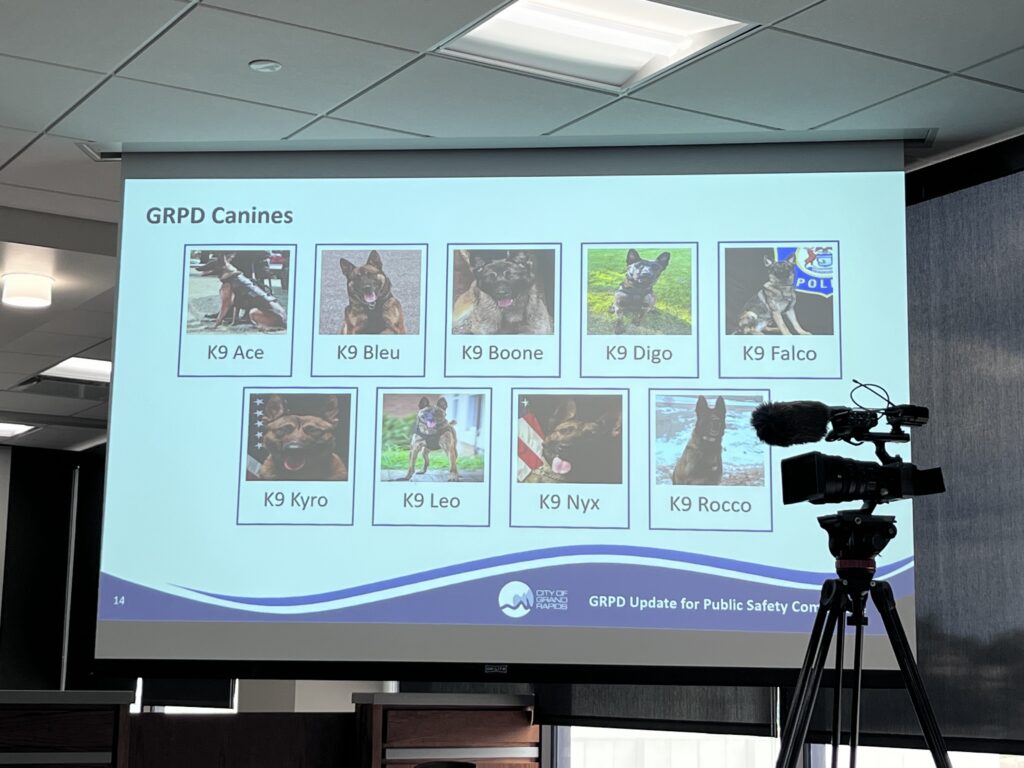
GRPD has nine police dogs, all German Shepherds, Belgian Malinois or Dutch Shepherds. The canines are imported from Europe, Baker said, and average careers of seven to nine years.
Roughly half are trained to detect narcotics, and half are trained to sniff out explosives. All dogs are also trained in patrol. Both the canines and their handlers are nationally certified. Between 2021-25, GRPD documented 14,500 hours of training for K-9s.
The policy review follows the fatal officer-involved shooting of Da’Quain Johnson in February, where a K-9 was deployed. Kent County Prosecutor Chris Becker declined to press charges against the officer in that shooting.
City Manager Mark Washington asked if GRPD could publish the K-9 training manual online, and both Baker and Trigg said that was possible. Marlin Feyen, a citizen member of the board, said he observed K-9 training and was impressed with the discipline of both the dogs and their handlers.
Write to juliana@grherald.com