
Although the Grand Rapids Police Department is already prohibited from civil immigration enforcement, small groups of protesters are a regular presence at city commission meetings, demanding sanctuary policies.
Activists from Movimiento Cosecha and GR Rapid Response to ICE have attended city commission meetings, demanding that Grand Rapids adopt six sanctuary policies. Protestors have disrupted both city and county commission meetings, forcing those meetings to adjourn.
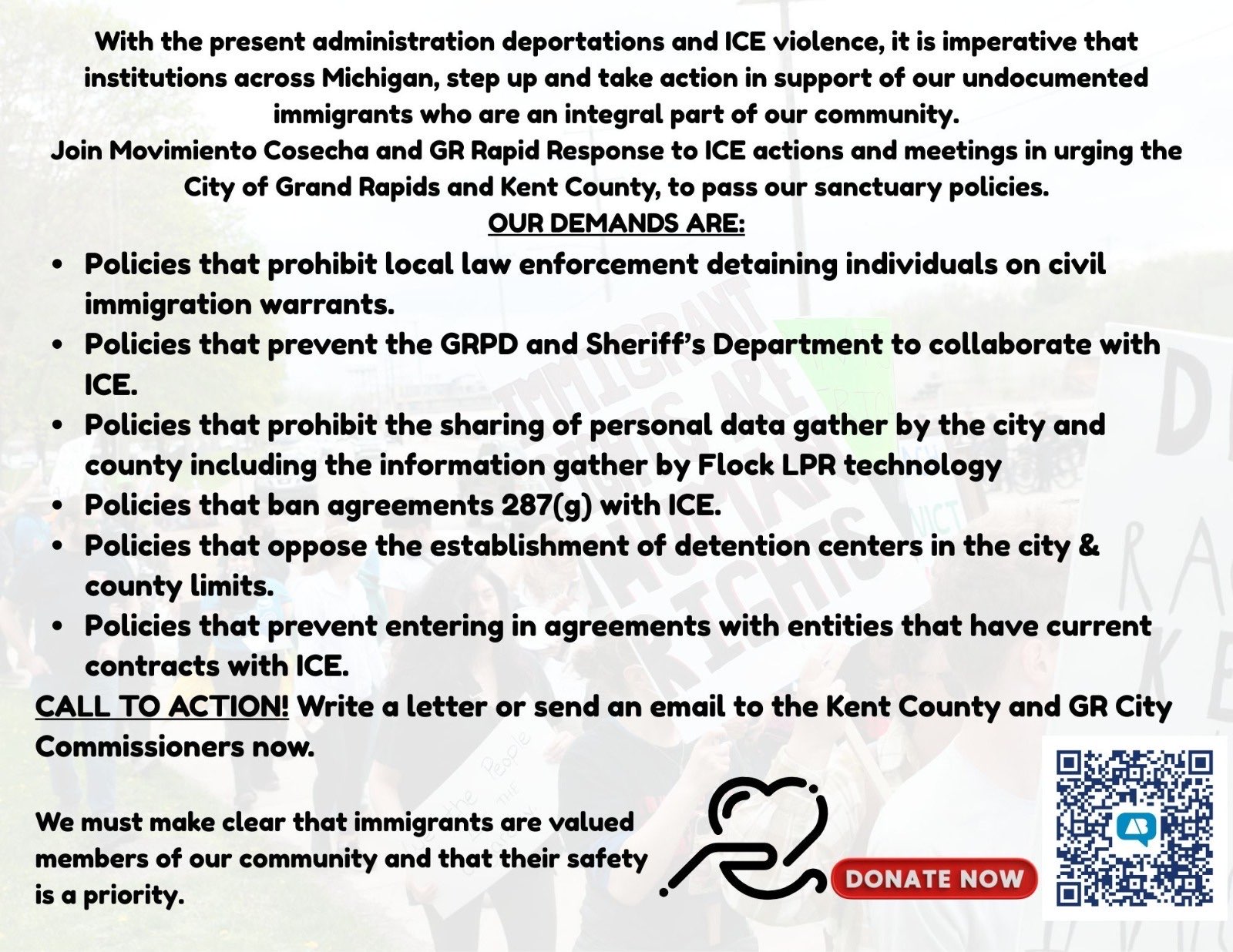
Last week, Mayor David LaGrand argued that the city has already met several of the demands. Any demands not met, he said, were either incoherent or not in the domain of a local government.
GRPD policies, on the books since 2019, support the mayor’s claims.
“GRPD is neither responsible for, nor has the authority to, enforce federal civil immigration laws used to detain or remove undocumented immigrants from the United States. This means that GRPD does not serve as a civil immigration enforcement agency for the federal government,” stated a GRPD spokesperson via email.
Grand Rapids has no 287(g) agreements with the Department of Homeland Security. Detailed in Section 287(g) of the 1996 Immigration and Nationality Act, the provision allows DHS to deputize local and state police departments to conduct federal immigration enforcement.
Juan Avilez, a policy associate on the state and local initiatives team at the American Immigration Counsel, said these agreements are the main vehicle by which local law enforcement assists federal agencies in immigration enforcement.
In Michigan, only four police departments have a 287(g) agreement with Immigration and Customs Enforcement, none being in West Michigan.
The GRPD Manual of Procedure prohibits officers from asking individuals seeking police services about their immigration status. GRPD officers are also not allowed to stop, question or arrest someone solely on his or her perceived immigration status. Outlined in Section 7-12 of the MOP, the only times police officers may look into immigration status is when federal, state or city law demands it, for consular or diplomatic notification, or if relevant to a criminal, not civil, investigation.
There is no set legal definition of a sanctuary city, said Colleen Putzel-Kavanaugh, associate policy analyst for the Migration Policy Institute. Many sanctuary policies concern information sharing with federal immigration agencies.
Most immigration enforcement is done by local police departments who apprehend and detain individuals living in the U.S. illegally, Putzel-Kavanaugh said. Per policy, GRPD does not honor immigration detainers, which is holding an individual for up to 48 hours of when they would normally be released. The department also does not stop, question, search, arrest, or detain someone solely based on an administrative immigration warrant, a warrant signed by an ICE agent, not a judge.
“If ICE is looking for someone in the community, it requires more personnel, more investigation,” Putzel-Kavanaugh said.
Demands on staffing are why many local law enforcement agencies don’t assist with immigration enforcement, said Avilez. GRPD has only recently had full staffing. The department had a 40-officer staffing shortage during former Chief Eric Winstrom’s tenure.
“A lot of the debate has come down to practicality for local law enforcement,” Avilez said.
Section 7-12 also governs assisting federal immigration officers. GRPD may assist in the event of an emergency which poses a threat to either the public or to federal officers or in non-emergency events, such as traffic control.
Protesters have also demanded GRPD refrain from sharing license plate data collected from Flock cameras with federal immigration agencies. GRPD officers must unselect “Immigration Violation” for alerts, and if immigration violations are the only reason for a license plate reader violation, GRPD is prohibited from taking any enforcement action, Section 8-14 of the MOP states.
Outside law enforcement agencies may request data that must be approved and documented. Multi-jurisdictional task force members, like the Kent Area Narcotics Enforcement Team, are allowed access to the database, but must follow GRPD policies.
License plate data is stored for 30 days. Any alert must be verified through dispatch or another database and visually to avoid errors.
Another demand is to ban the construction of detainment facilities in Grand Rapids and Kent County. The Supremacy Clause of the U.S. Constitution states that federal law trumps local and state law, and most local governments have interpreted that to mean federal immigration enforcement can supersede local zoning laws. Public backlash has prevented the conversion of warehouses to detention centers, as happened recently in Romulus, Mich.
“There’s been pushback, even in Republican areas, where we would anticipate more cooperation,” Putzel-Kavanaugh said.
Cosecha Movimiento and GR Rapid Response have also demanded the city of Grand Rapids not enter into agreements with any entity which cooperates with ICE. LaGrand expressed skepticism at this proposal, which he said the groups demanding had conceded.
“I don’t think it’s possible for the city to not contract with anybody who also contracts with the federal government,” LaGrand said at last week’s meeting.