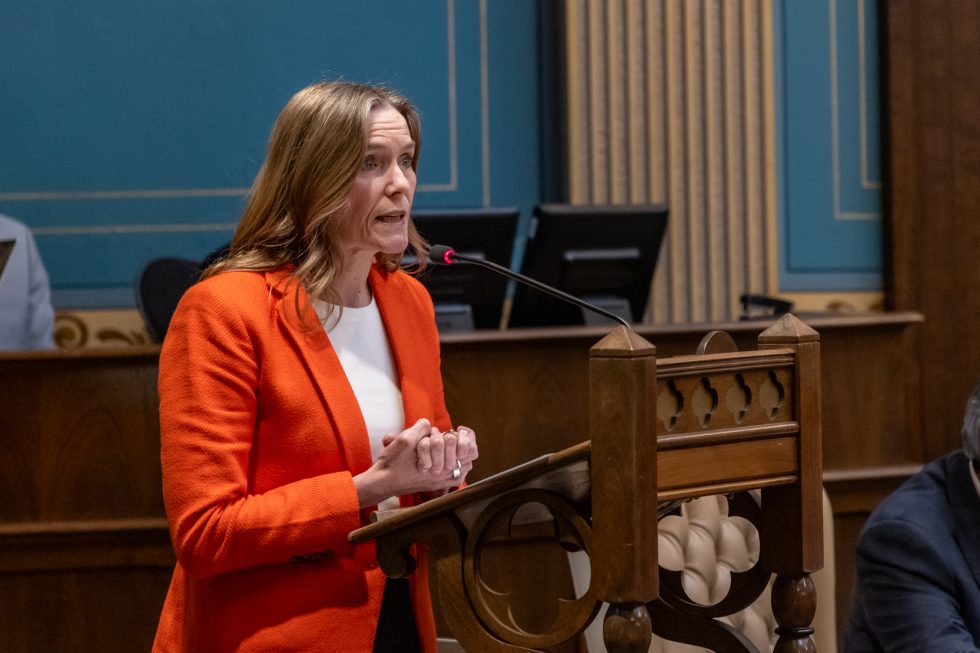
State Sen. Winnie Brinks of Grand Rapids is being considered as a potential lieutenant governor for Democratic nominee Jocelyn Benson.
A short list included Brinks, former Senate Minority Leader Jim Ananich of Flint, and current Senate Appropriations Chairwoman Sarah Anthony of Lansing, the Detroit News reported.
Benson secured the Democratic nomination for governor on Tuesday. Her campaign did not return a request for comment.
Media representatives for Brinks, who is serving her last term in the state legislature allowed by term limits as the Senate Majority Leader, declined to confirm her consideration.
“Being considered for positions of leadership is always a humbling experience for me,” Brinks said via email. “From being asked to run a write-in campaign for state House 14 years ago to being entrusted to lead the Senate in the first Democratic majority in 40 years, I’m grateful for the faith my constituents and colleagues have in me.”
Since the start of the 103rd Michigan Legislature, the Democratic-controlled Senate and Republican-controlled House have largely been at an impasse, excepting a slate of bipartisan bills aimed at cutting zoning regulations and incentivizing the construction of new housing. Brinks refused to take up bills passed by the House that would roll back requirements for electricity providers to source 100% clean energy by 2040 and that would ban transgender girls from playing in female sports.
In the last week, Brinks reintroduced nine bills that were the subject of a 18-month legal battle. Absent concessions, House Majority Speaker Matt Hall (R, Richland Township) said the House would not consider those nine bills, which would increase public employer contributions to their employee’s healthcare costs, allow Detroit museums to seek millages and allow Department of Corrections employees to enter in Michigan State Police’s retirement plan, among other things.
A graduate of Calvin College and a mother of three, Brinks was the executive director of a nonprofit residential facility for nonviolent female offenders and had worked as a school paraprofessional prior to politics.
Brinks first entered elected office after incumbent and longtime Democrat State Rep. Roy Schmidt switched party affiliation to Republican shortly before the primary filing deadline in 2012. Although no charges were filed against Schmidt, then Kent County Prosecutor William Forsyth, a Republican, called the last-minute change unethical.
Brinks won the Democratic nomination through a write-in campaign and then unseated Schmidt for the State House 76th District. She later sponsored legislation that would allow parties 14 days to select a new candidate, should the incumbent switch affiliation.
Brinks served three terms in the Michigan state legislature as a representative and is serving her second term in the State Senate. In 2022, she was selected as Senate Majority Leader, the first woman to hold the role in state history.
In her tenure as a senator and representative, Brinks has sponsored 156 bills. Of those, six have been signed into law by Gov. Gretchen Whitmer and by then Gov. Rick Snyder: a 2021 bill which exempted medical imagery equipment from requiring state review, a 2021 bill which created a new property tax break for developers, a 2021 bill exempting feminine hygiene products from use taxes, a 2021 liquor regulatory reform bill, a 2020 bill creating a veteran’s facility appeals board, and a 2015 bill to modernize references to deaf persons in the state criminal code.
Prior to the passage of Proposal 3, a ballot initiative which enshrined the right to abortion in Michigan’s Constitution, Brink sponsored several bills to establish a right to abortion and repeal restrictions on it.
Her voting record has won her high marks from the Michigan AFL-CIO Advocates, a labor union lobbying group, and the Michigan League of Conservation Voters. The West Michigan Policy Forum, a pro-business lobbying group, gave Brinks an “F” grade for her vote to repeal “Right to Work” legislation and vote against requiring third graders meet reading proficiency benchmarks.
District 29 encompasses all of East Grand Rapids, Grandville, Kentwood, and Wyoming City, as well as parts of Grand Rapids and Grand Rapids Charter Township.
Write to juliana@grherald.com