
Several Grand Rapids businesses told The Grand Rapids Herald they are frustrated with the city after it has seemingly failed to take meaningful action to confront the accumulation of human feces and needles around their downtown storefronts.
Businesses say the issue is concentrated near parking ramps and public parks. Area business owners claim these locations have been left unmonitored by security guards since the onset of the pandemic in 2020, allowing bad actors to proliferate.
Each establishment agreed to speak with The Grand Rapids Herald on the condition of anonymity out of concern that their comments could negatively impact their reputations.
The general manager of one downtown restaurant told The Herald her location has resorted to installing gates in its back alley to protect staff, some of whom have been harassed by loiterers.
“There’s a lot more gating just because there’s a lot more people hanging out there all day, going after the staff, sleeping back there, doing drugs back there,” she said of the alley. “I have repeatedly reached out to the city, tried to get people out here to walk through it, but I don’t think there has been a good solution.”
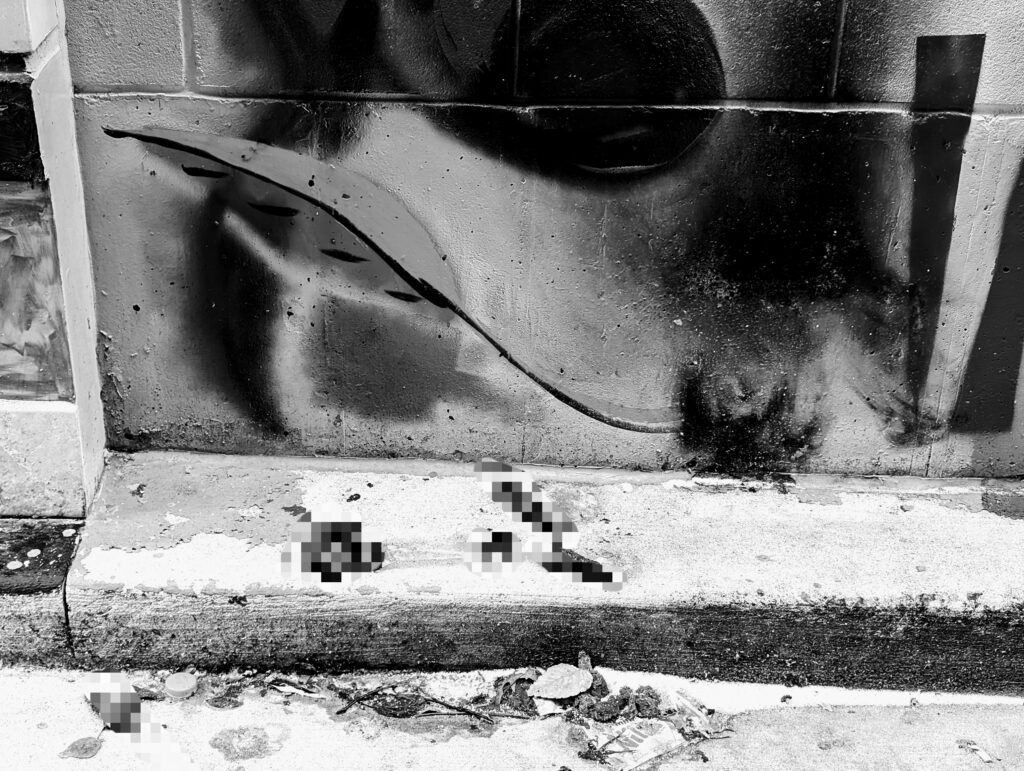
Upon examining the location in question, The Herald found at least two deposits of what appeared to be human feces just steps from the restaurant. The situation not only harms her business but poses a hazard to customers, she said.
“The feces is disgusting but there is a large issue of needles and a lot of hazardous stuff that, if the wrong person was walking through and wasn’t aware of the situation, they would probably be hurt,” she said.
She also noted that restaurant ownership has repeatedly pleaded for action at city commission meetings and even walked commission members through the alley. Despite her efforts, the city redirects their concerns toward its Homeless Outreach Team (HOT) which she claims is ineffective.
“[HOT] can get them away, but it doesn’t do anything, they come back,” she said of the loiterers. “We watch our cameras and at three in the morning they’re destroying our alley, throwing everything out of our dumpsters, trying to break into our liquor cage.”
“It’s not the police’s fault, they do the best that they can when they come here, they’re just as frustrated as we are,” she added. “The police know most of their names.”
Without some sort of intervention by the city, she said she fears matters will only get worse when the Acrisure Amphitheater opens.
“It’s an uncomfortable conversation, but there is a problem down here, and the amphitheater is only going to make it worse,” she said. “How does that make the city look with thousands of people coming into the city for the first time, and what if you park at Cherry-Commerce?”
These frustrations, she noted, are compounded by the amount of taxes the city collects from her business.
“It’s frustrating, because I know how much we pay in taxes, and it seems like someone could help us or have this conversation about what the plan is with the homeless population,” she said. “I don’t think it’s a conversation anybody wants to have. People are just kind of letting it exist.”
One downtown market business owner, who also asked to remain unnamed, told The Herald he has repeatedly encountered issues with nearby drug dealers since opening his establishment in 2013. He suggested city nonprofits that focus on homelessness are enabling the problem and harming taxpaying businesses in the process.
“The empathy has reached a toxic level, and because of that, nobody wants to touch the notion that something needs to change, and it needs to be a drastic change, and it’s going to require possibly hurting people’s feelings,” he said.
“We have people coming to this city specifically because of the handouts and the services and the accommodations,” he added. “There’s an overkill mentality of support.”
The proprietor compared the situation to his time living in Seattle, where he witnessed similar problems go unchecked by city government.
“It’s just an accepted reality now, and that’s a very slippery slope, because once we say ‘yeah, ok, this is the way it is,’ it just gets worse and worse and worse and completely unchecked,” he said.
A City of Grand Rapids spokesperson told The Herald via email that the city was aware of the concerns and is “committed to addressing them in a collaborative manner” with HOT and local police.
The spokesperson added that the city has “implemented a range of proactive measures” to address the concerns, including “routine cleaning,” “daily outreach,” and “actively addressing encampments.”
In response to questions about the opening of the Acrisure Amphitheater, the spokesperson said the city is preparing accordingly to accommodate an influx of visitors.
“The City is committed to having a clean, safe and welcoming downtown for businesses, residents and visitors,” the spokesperson wrote via email. “As activity increases with new amenities like the Acrisure Amphitheater, the City will continue its multi-departmental and partnership approach to address and prevent issues downtown. This includes, but is not limited to, daily outreach, corridor cleaning and maintenance and activation of public spaces to support positive activities for all to enjoy.”
Neither the City Commission nor the mayor’s office responded to requests for comment.
HOT received a more than $3 million operating budget in 2026, according to the city’s 2026 fiscal year plan. The non-governmental organization Downtown Grand Rapids Inc. also received more than $200,000 for “contract security” throughout the downtown area and city parks.